Did you know that the Philippines first had to fight Spain and then the US before gaining independence? Although victory over the Spanish colonists was achieved, the US effectively took over as colonialists from the Spanish.
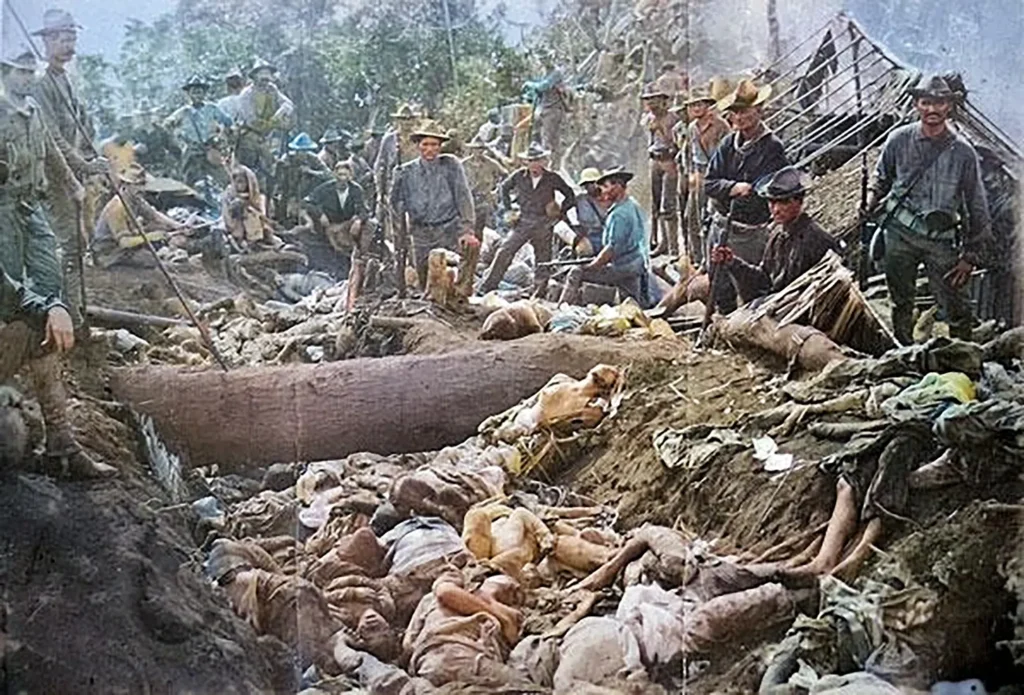
US-soldiers pose with bodies of Moro insurgents. Philippines 1906.
Every June 12, at the Aguinaldo Shrine in Kawit, Cavite, the 1898 Philippine Declaration of Independence is read aloud from the balcony where it was first proclaimed. Parades roll through cities across the country. In Manila, the president gives a speech and a 21-gun salute follows. there’s a bitter irony in all this pageantry. The republic being celebrated was killed in its infancy. Not by Spain, the empire it defied, but by the United States, the empire that took Spain’s place. “June 12th is supposed to be Philippine independence day,” BAYAN-USA chairperson Bernadette Ellorin once said. “But in reality, the Philippines is anything but free.” A hundred and twenty-eight years later, the old question still stands. Independence for whom? And from whom?
The revolution that broke out in August 1896 was a class revolt before it was anything else. The Katipunan was founded by Andrés Bonifacio, a warehouse clerk from Manila. Its strength came from workers, peasants and the urban poor, people bled dry by three centuries of friar landlordism and colonial tribute. The historian Teodoro Agoncillo called it the first genuinely popular revolution in Asia. Cuba’s uprising against Madrid had shown it could be done.
The revolution did not survive its own leadership. In 1897, after a factional fight in Cavite, the landed ilustrado wing around Emilio Aguinaldo took control. Bonifacio was tried on fabricated charges and shot. For the nationalist historian Renato Constantino this was the original sin of the Philippine nation. The propertied class had captured a mass revolution, and a captured revolution can be sold. Aguinaldo soon took Spanish money and exile at Biak-na-Bato. He came back only when a new patron appeared.
That patron was Washington. The USS Maine sank in Havana harbor in February 1898. By April the US had blockaded Cuba and the Spanish-American War was on. Commodore Dewey destroyed the Spanish fleet in Manila Bay on the first of May. Aguinaldo came home on an American ship, allied himself with the US, and by June, Filipino forces held most of the countryside. On June 12 he declared independence. Not a single government on earth recognized it. Six months later, in Paris, Spain sold the Philippines to the United States for $20 million. The people who had actually liberated the country weren’t in the room.
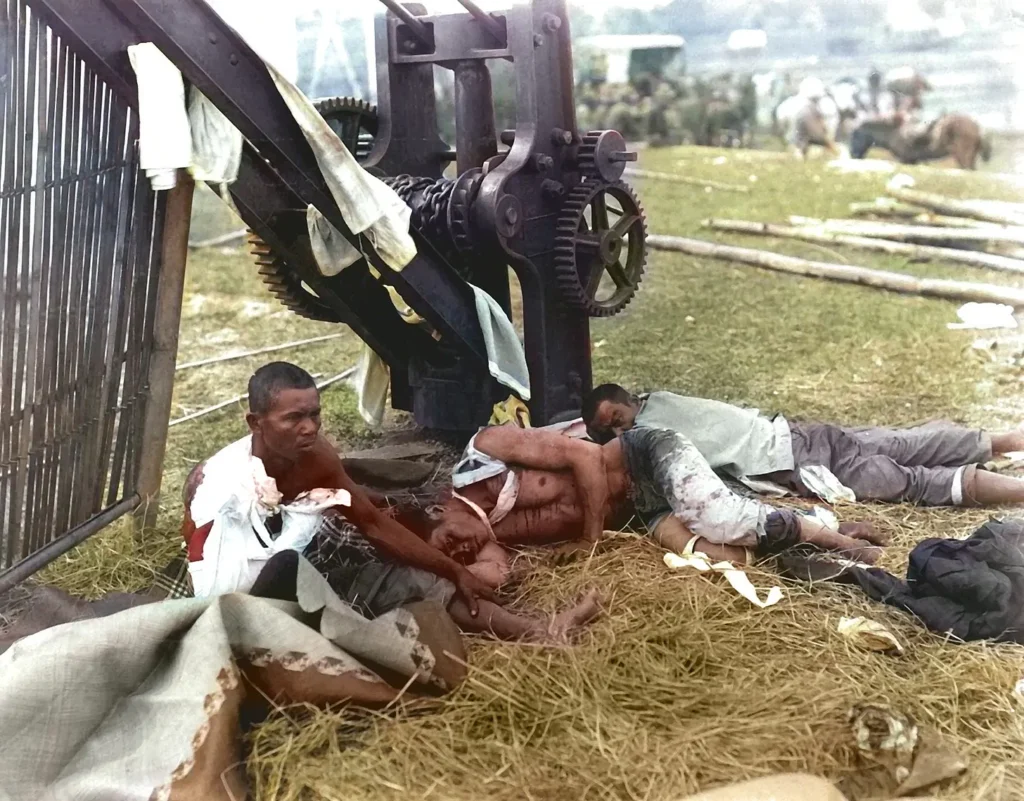
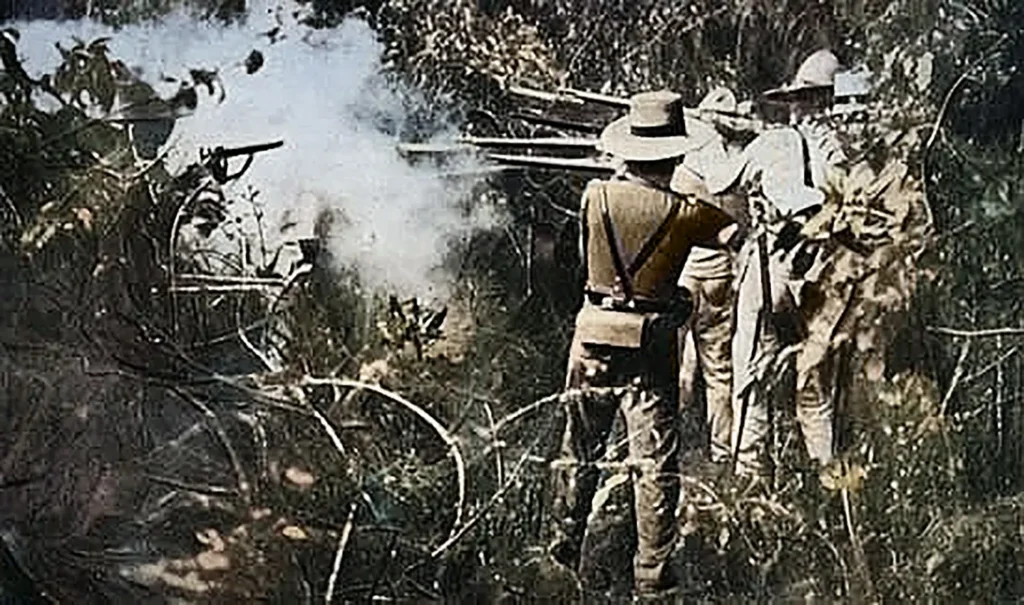
What followed was one of the bloodiest colonial wars in history, and one of the most forgotten. Fighting broke out in Manila in February 1899. President McKinley called the conquest “benevolent assimilation.” On the ground it meant scorched earth, reconcentration camps and water torture. By the war’s official end in 1902, somewhere between 200,000 and a million Filipino civilians were dead, most of them from the famine and disease the campaign left behind. Mark Twain, then vice-president of the Anti-Imperialist League, suggested the American flag be redrawn “with the white stripes painted black and the stars replaced by the skull and cross-bones.”
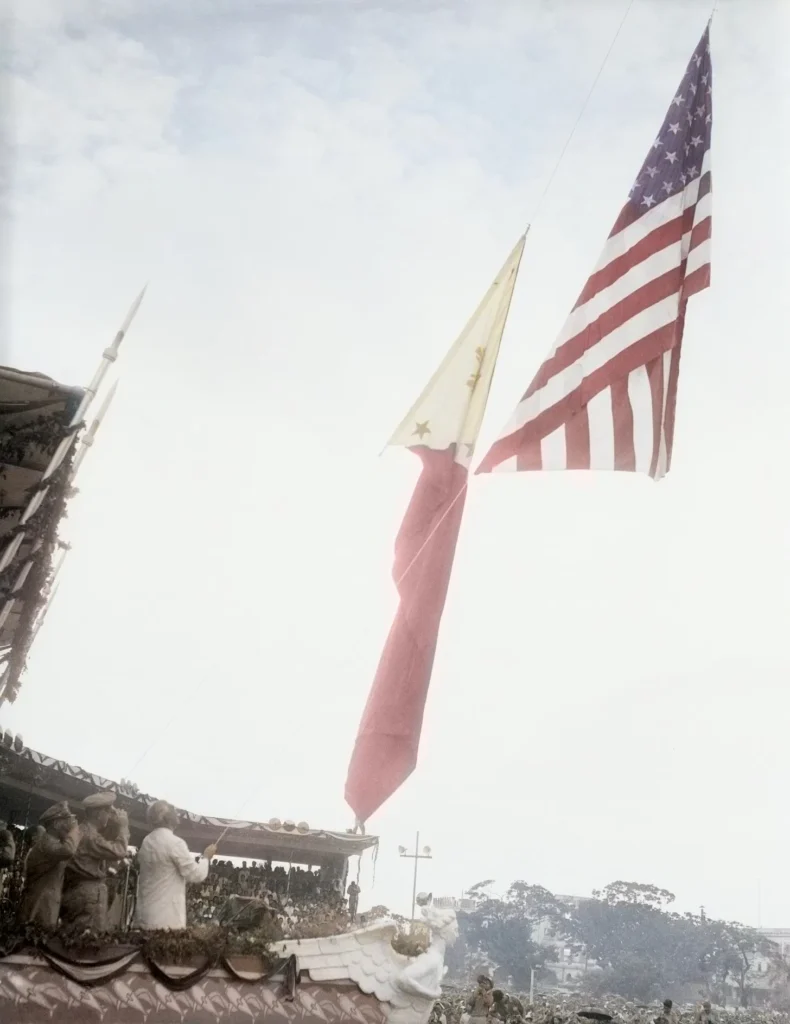
Even the date of freedom was an imperial gift. Washington “granted” independence on July 4, 1946. America’s own birthday. The Philippines only took June 12 back as its national day in 1962. And the 1946 settlement came shackled. The Bell Trade Act gave US citizens parity rights over Philippine resources. The Military Bases Agreement planted American garrisons on a 99-year lease. Dozens of unequal treaties followed, administered by what BAYAN calls a succession of “puppet governments.” This is the continuity the revolutionary left calls the second betrayal. When Jose Maria Sison re-established the Communist Party of the Philippines on December 26, 1968, its founding analysis, Amado Guerrero’s Philippine Society and Revolution, described the republic as “semi-colonial and semi-feudal,” sick with three basic problems: US imperialism, feudalism and bureaucrat capitalism. Three months later, on March 29, 1969, the party founded the New People’s Army. The protracted people’s war it launched was framed, explicitly, as picking up where Bonifacio left off. Five decades on it’s Asia’s longest-running communist insurgency, filmed from inside the guerrilla zones in redfish’s Inside the New People’s Army (2018).
You can still see the colonial economy with your own eyes on Negros, where a sugar monocrop set up by British and American capital in the 1850s defines life to this day. In a statement for what it calls the “reactionary’s Independence Day,” the NPA’s Negros command points out that cane cutters work with the same machetes and shoulder-loads their great-grandfathers used, for wages that have barely moved. Meanwhile peasants accused of supporting the revolution are red-tagged and killed by a US-trained military. There can be no real independence, the statement argues, “when the vast number of Filipino people has little to no land, has no job or income.”
The legal mass movement reaches the same conclusion. Bayan, founded in 1985 in the fight against the US-backed Marcos dictatorship, argues the 2014 Enhanced Defense Cooperation Agreement is actually worse than the old bases it replaced. Under EDCA the US military is no longer confined to Subic and Clark. It can position forces virtually anywhere in the country, as the spearpoint of a “pivot” that committed 60 percent of US naval forces to the Asia-Pacific to face China. Caught between a declining superpower and a rising one, the Philippines exports its own people instead of developing. Thousands leave every day to work abroad. Remittances stand in for the national industrialization and land reform the movement has demanded since 1896.
The verdict of history is hard to escape. The bourgeois capture of the revolution condemned the country to a century of underdevelopment. The evidence is everywhere: a land question never resolved, an economy hooked on dependency and on exporting its own children, an elite that from Aguinaldo to today’s dynasties has chosen accommodation with empire every single time it mattered. June 12 can’t be left to the generals and their gun salutes. The reading at Kawit isn’t commemoration. it’s an indictment. The promise made from that balcony in 1898 was never kept, and it won’t be honored by the class that broke it. it’ll be honored, if at all, by the workers and peasants who first made it.
So a question hangs over every flag raised this June 12. Can real change come from anything less than changing society itself? that’s the wager the movements founded in 1968 and 1969 have been making for over half a century, together with the mass organizations fighting in the streets and across the diaspora. The bet is that genuine independence arrives only when the present order is replaced entirely, with a society that’s classless and anti-capitalist, free not just from colonialism and imperialism but from the chains of class society and capital itself. Maybe that’s the hope Bonifacio carried and Aguinaldo betrayed, still waiting in the cane fields of Negros and on the picket lines of Manila. Marx said it plainly enough. The workers have nothing to lose but their chains. They have a world to win, and a country with it.
Sources
Teodoro Agoncillo, The Revolt of the Masses: The Story of Bonifacio and the Katipunan (University of the Philippines Press, 1956)
Renato Constantino, The Philippines: A Past Revisited (Tala Publishing, 1975)
Amado Guerrero, Philippine Society and Revolution (1970)
Jose Maria Sison, The Philippine Revolution: The Leader’s View (Crane Russak, 1989); Struggle for National Democracy (1967)
Communist Party of the Philippines founding documents, “Rectify Errors and Rebuild the Party” (1968); NDFP, ndfp.org
Howard Zinn, A People’s History of the United States, ch. 12 “The Empire and the People” (1980)
Mark Twain, “To the Person Sitting in Darkness,” North American Review (1901)
Stanley Karnow, In Our Image: America’s Empire in the Philippines (Random House, 1989)
Bayan (Bagong Alyansang Makabayan), statements on EDCA and US basing, bayan.ph
BAYAN USA, “Filipino Americans Commemorate Philippine Independence Day with Actions to Defend Philippine Sovereignty” — https://www.bayanusa.org/blog/filipino-americans-commemorate-philippine-independence-day-with-actions-to-defend-philippine-sovereignty
BAYAN USA, “July 4th — Is the Philippines Truly Independent?” — https://www.bayanusa.org/blog/july-4th-is-the-philippines-truly-independent
NPA Negros Island Regional Operational Command (Apolinario Gatmaitan Command) / NPA-Northern Negros (Roselyn Jean Pelle Command), “Reactionary’s Independence Day, Negrosanons continued cry for genuine independence and national democracy!”, June 16, 2024 — https://philippinerevolution.nu/statements/reactionarys-independence-day-negrosanons-continued-cry-for-genuine-independence-and-national-democracy/
New York Times archive coverage of the Treaty of Paris (1898) and the Philippine–American War (1899–1902)
More Stories
IMF report details a financial system with rising risks and vulnerabilities
Bowing to Washington’s pressure, Sri Lanka and India refuse to provide aid to Iranian ships
Marco Rubio declares West must dominate world, praises colonialism, erases history