
The movement in the US against the Vietnam War mobilised millions against the government, and became a lightning rod for the demands of a huge layer of the oppressed. In this context, a powerful revolutionary party could have been built to challenge the might of US imperialism from within. In this article, Tom Trottier details the rise of the anti-war movement, and how this historic opportunity was missed.
[This article was originally published as part of issue 52 of In Defence of Marxism magazine – the quarterly theoretical magazine of the Revolutionary Communist International. Subscribe and get your copy here]
After the Second World War, US imperialism stood as a mighty economic and military power. This ‘colossus’ was unique. Was there ever an imperialist power that had such wealth and massive firepower, including the atomic bomb? The US military proudly proclaimed that they never lost a war. All this changed with the war on Vietnam.
The US government threw everything it could against the Vietnamese people in order to maintain its imperialist domination. Their actions failed to crush the resolve of the Vietnamese, but they helped to spur a large anti-war movement right in the belly of the beast. The trajectory of the war led to mass radicalisation at home. The stability of US capitalist rule was turned into its opposite.
At its height, the anti-war movement brought millions of people out onto the streets and became a lightning rod for the other mass struggles of the period. There were incredible opportunities to build a large communist party, capable of uniting all of these struggles and giving them a revolutionary leadership. Tragically these opportunities were squandered.
Today, in the context of a rising anti-imperialist mood across the world, revolutionaries have much to learn from a study of the period.
Containment
The Second World War firmly cemented the position of the USA as the world’s dominant imperialist power. Meanwhile, the Soviet Union, having won the war against Nazi Germany, emerged conclusively as a world power. This, combined with the establishment of Stalinist regimes throughout most of Eastern Europe, enormously strengthened the authority of Stalinism in much of the world.
The war also put the question of colonial revolutions firmly on the agenda across much of the globe, with Stalinised communist parties poised to play a leading role. US imperialism tried to implement a policy of ‘containment’. They wanted to defeat the colonial revolutions, and stop, or at least limit, the expansion of Stalinism around the world. But the war weariness of the US troops limited the imperialists’ options for direct military intervention in the immediate years following the war.
After Japanese imperialism was defeated in 1945, France sought to reclaim its colonies in Indochina, which it did with the backing of the US. Following the Chinese Revolution of 1949 and the Korean War of 1950-53, the American bourgeois talked about the ‘domino theory’, where supposedly if capitalism were toppled in one country, its neighbours would fall in quick succession. Hence they were determined to prop-up capitalism in Vietnam, which they saw as vital to preserving their interests in the entire region.
From 1945 to 1954, the Vietnamese people, under the Stalinist leadership of Ho Chi Minh, fought and defeated the French, culminating at the Battle of Dien Bien Phu. After the defeat of the French, the US moved in and created the state of ‘South Vietnam’. This set up the context for a war of national liberation against US imperialism and its puppet regime in the south.
The corrupt comprador government in South Vietnam created a choice for US imperialism: abandon Vietnam and watch capitalism get overthrown, or send in the US military to defeat the liberation forces. The imperialists’ attempts to prop up capitalism abroad, however, would ultimately destabilise their system at home, with the rise of a mass anti-war movement.
Rumbling in the belly of the beast
The conditions for the development of this movement had been prepared over the previous decades.
For example, there was a profound change in race relations in the aftermath of the Second World War. Having put their lives on the line during the war, many black former soldiers were no longer willing to put up with Jim Crow segregation in the south when they returned home.
In the north, although segregation was not as explicit as in the south, there was in fact a conscious policy of segregation in housing which dictated where people could live. All of this was supplemented with a system of racist murders, which were effectively condoned by the state.
These conditions created an enormous civil rights movement in the 1950s that continued into the 1960s. Black Americans became radicalised over this period. The violence used by the police against the civil rights demonstrators did not defeat the movement, but made it stronger and more widespread.
The civil rights movement helped radicalise a much wider layer of youth in the early 1960s. By mid-April 1960, according to one estimate, some 50,000 students had participated in civil rights sit-ins.[1] Added to this was the development of the Cuban Revolution, and the glaring poverty in the world’s richest country. Lots of students were thus becoming politically active, compared with the relative quiet and conformism of the 1950s.
The Students for a Democratic Society, known as SDS, released its ‘Port Huron Statement’ in 1962. Although it did confront the widespread anti-communism of the cold war, this document was basically a liberal critique of US society, as it did not challenge the capitalist system. Nevertheless, in the political vacuum that existed in the 1960s, the SDS grew explosively.
The impact of the draft
From 1954 to August 1964, the US limited its role in Vietnam to mostly funding, arming, and training its puppet regime in the south. When it became clear in 1964 that the South Vietnamese state was about to collapse, the so-called ‘Gulf of Tonkin incident’ was used as a pretext to significantly increase the US’ military presence and direct intervention.
Many thousands of troops, ships and bombers were sent to Vietnam, eventually reaching 543,000 military personnel in January 1969.[2] US Army General William Westmoreland, a veteran of Korea and the Second World War, was put in charge from 1964 to 1968.
Over 1.8 million Americans were drafted during the course of the war.[3] Since troops were transferred in and out, it was estimated that about 2.7 million US soldiers, marines, sailors and airmen were sent to Vietnam at one time or another.[4]
The military draft played an important role in the consciousness of the youth and in developing opposition to the war. Under the guise of ‘fighting communism’, an entire generation of youth was subject to being forced into the US military to risk being killed or disabled for life in the jungles of Southeast Asia. This was a giant sword of Damocles hanging over young people – and their families.
The class question also created anger against conscription. Whenever there is a military draft, the rules for workers are different to those for the wealthy. College students could defer their military service until after they graduated, resulting in a disproportionate amount of working-class youth being forced into the military. Those with connections to a doctor could be excused for combat on medical grounds.
Race was also a factor. Non-white Americans were disproportionately assigned to combat forces. Blacks and latinos therefore made up a larger proportion of casualties in the war, than their share of the US population at the time.[5]

The imperialists unleashed hell on the people of Vietnam / Image: public domain
These tensions were revealed when the US military tried to draft the famous boxer Muhammad Ali in 1967. When Ali resisted, he was arrested, prohibited from boxing, and sentenced to five years in prison. In justifying his decision, Ali explained that:
“Why should they ask me to put on a uniform and go ten thousand miles from home and drop bombs and bullets on brown people in Vietnam while so-called Negro people in Louisville are treated like dogs and denied simple human rights?
“I will not disgrace my religion, my people or myself by becoming a tool to enslave those who are fighting for their own justice, freedom and equality.”
Although Ali was vilified in the media, his action no doubt struck a powerful chord with many young black people being called up to fight. Many soldiers lived in the midst of the discrimination Ali described, and there is no question that the civil rights struggle and the anti-war movement at home appealed to them. Later, these factors would ripen into revolts in the US military itself.
Opposition grows
The US Air Force started bombing targets in North Vietnam in February 1965. General Curtis LeMay, who had been involved in US bombing of Japan in the Second World War, proudly boasted that the US could bomb Vietnam “back to the stone age”. Indeed, in terms of bomb tonnage, the US dropped more explosive material on Vietnam than all sides dropped in the Second World War combined.[6]
The imperialists unleashed hell on the people of Vietnam, and eventually, Cambodia and Laos. But for the first time in history, the war was televised. The result was that whilst watching the carnage from their living rooms, many American workers and youth asked themselves: why is this happening?
The capitalist television media is a business that sells advertisements. Although they of course portrayed a pro-US line, they also wanted to capture the gritty reality of the war, which certainly is the greatest drama. Television, newspapers and magazines showed graphic and ugly pictures of this war, in a way that had not been done in the past. I can remember being about ten years old and seeing the daily ‘body count’ reported on the TV news. This was relentless and had an enormous effect on the thinking of the entire population.
The imperialists unleashed hell on the people of Vietnam / Image: public domain
The American people were told it was a war ‘against communism’. But in the media they saw the reality of old people and children being killed or wounded. Vast regions were subjected to carpet bombing, or the dropping of napalm and the defoliant ‘Agent Orange’. Entire villages were burned to the ground by US troops.
Many came to see the insanity of the war when it was reported that a US major, commenting on the Battle of Bến Tre, said: “It became necessary to destroy the town to save it”. The public were shown how the US would take territory, then abandon it, and then retake it again soon after. What really was being accomplished?
As the war expanded, there was an increase in anti-war activity on many university campuses, including teach-ins on the war. SDS decided to call for an anti-war march in Washington on 17 April 1965. Between 15,000 to 25,000 people attended that demonstration, which was far beyond their expectations.[7]
SDS was not the only radical force that grew, but it was the largest. There were also various peace coalitions organised, which mobilised the mass demonstrations and gathered together many newly politicised youth.
With the growth of the anti-war movement, the leadership of the movement moved to the left politically. Prior to the April 1965 March on Washington, the anti-war movement was led by SANE, a liberal anti-communist group. Now, communists, socialists, pacifists and radical youth would take the lead.
The war dragged on and the US military deployment significantly increased. Dialectically, its opposite also grew: the anti-war movement. Demonstrations in late October 1967 included 300,000 participants in New York City, and another 50,000 in Washington, DC. It was estimated that up to 10 million people were part of the movement during the course of the war.[8]
The turning point: the Tet Offensive
US imperialism needed to completely defeat the national liberation movement. Anything short of that would mean the US had lost. The Vietnamese knew that if they continued to fight, they would win.
President Lyndon B. Johnson counseled patience and advised that victory was around the corner. Throughout 1967 to 30 January 1968, the triumvirate of President Johnson, Secretary of Defence McNamara and General Westmoreland, kept pushing the line that the Vietnamese communists were ‘near defeat’. Ironically, this played into the hands of the communists, who launched the Tet Offensive on 30 January 1968.
Tet is the Vietnamese New Year celebration and a major holiday. Choosing this date for the offensive caught the US imperialists and the South Vietnamese regime by complete surprise. The People’s Army of Vietnam (PAVN – also known as the North Vietnamese Army) and guerrilla units in the South, under the leadership of the National Liberation Front (NLF) simultaneously attacked 100 cities, towns and US military bases, including parts of the Southern capital, Saigon.
On the surface, the Tet Offensive was a failure. In the end, the North Vietnamese and the NLF lost 45,000 soldiers with another 7,000 taken prisoner, without succeeding in maintaining control over any of their targets. More than 14,000 civilians were killed. The US and their Vietnamese allies lost more than 6,000 soldiers, and over 15,000 were wounded.
But these numbers were not the main story. The massive offensive dealt a psychological blow from which US imperialism never recovered. It was shocking to the large section of the American people that had believed Johnson’s propaganda. Further, it was clear to all that the Vietnamese died fighting to free their country from the grip of imperialism. What did the US soldiers die for?
General Westmoreland’s reaction to Tet was to request another 200,000 troops, to bring the US total to almost 750,000. His request was leaked to the media, which helped give the public the sense that the war was unwinnable, and that the government’s previous assertions of a ‘near victory’ were a lie. Many people, including soldiers, began to see that the vast majority of the Vietnamese population was on the side of the communists, and opposed to the US and its puppet regime. Anticipating the unpopularity of this move, the request was rejected.
The Tet Offensive was therefore the key turning point in the war and a real victory for the communists. The American people began to distrust the government and turn against the war, as did many members of the US military.
1968: a revolutionary year
Like the year 1848, 1968 was clearly a year of revolution. The Tet Offensive took place at the beginning of the year, and it sent the message that people can rise up and struggle against their rulers.
In May, students in France moved into the streets, soon to be followed by a general strike of 10 million workers. In Czechoslovakia, the ‘Prague Spring’ increasingly drew workers into political action, before it was crushed by Soviet tanks in August. In Mexico from July to October, a mass movement of students erupted, which was put down with violent repression. Pakistan also went through a revolution, which brought down the dictator Ayub Khan.
The United States also experienced upheaval and revolts. Martin Luther King Jr. was the most recognised leader of the civil rights movement. He had come out publicly against the Vietnam War, and was helping to organise workers into unions as part of his ‘Poor People’s Campaign’.
King also made statements in support of “democratic socialism”, signalling that he was contemplating the possibility of publicly opposing the capitalist system. He was under constant surveillance by the FBI, and yet he was assassinated on 4 April 1968.
There were uprisings in over 100 cities when people heard that King was killed, which were brutally repressed by the state. These came less than a year after riots erupted in over 150 locations in response to racism.
The Tet Offensive also created a real split in the ruling Democratic Party. Minnesota Senator Eugene McCarthy decided to run against President Johnson in 1968 and challenge him for the Democratic Party’s nomination based on opposition to the war. McCarthy’s campaign really got momentum after Tet, when he did surprisingly well in the February New Hampshire primary. This spurred Senator Robert F. Kennedy to enter the race as an ‘anti-war’ candidate on 16 March. Shortly after, Johnson announced he would not run for re-election.
Robert Kennedy was later assassinated in June 1968, adding to the turbulence of the year.
In August, a section of the anti-war movement wanted to confront the Democrats at their convention in Chicago. But the mayor of Chicago organised an orgy of police repression to prevent this. The Chicago police and the National Guard brutally attacked the demonstrators with tear gas and truncheons, injuring hundreds. This was broadcast live on TV, whilst the protesters chanted “the whole world is watching”.
This shocked a layer of the population. Ron Ferrizzi, a US helicopter crew chief, upon watching the events on the TV in Vietnam, later recalled:

Anti-war march in San Francisco, 15 April 1967 / Image: public domain
“At that moment I realised that anyone who really cared for America was sent halfway around the world, chasing some ghost in the jungle, killing somebody else’s grandmother, for no reason at all. And in the meantime, my country is being torn apart. I saw someone who looked like my dad, hitting someone who looked like me. Oh my god, whose side would I be on?”[9]
Eventually, eight leaders of the anti-war movement, including Bobby Seale of the Black Panthers, were put on trial. Although five were convicted of ‘crossing state lines with intent to incite a riot’, their convictions were overturned on appeal.
The Democrats nominated Hubert Humphrey, the vice president under Johnson. But he lost the election to the Republican, Richard Nixon, who promised to end the war, but “with honor”.
1969: Imperialism retreats
Given all of the above, Nixon knew that he had to withdraw the US military as soon as possible. The government realised they couldn’t achieve their objectives with US ground forces, and they needed to curb the growing anti-war movement at home.
They therefore started drawing down troops in mid-1969, with Nixon saying they would replace the US troops with Vietnamese soldiers in a process called ‘Vietnamisation’. But although the military draft was reduced, hundreds of thousands of troops were to remain in Vietnam, with their phased withdrawal only scheduled to end in November 1972.
Meanwhile, reports of the US military’s massacre of civilians at the hamlet of Mỹ Lai in 1968 were made public in November 1969. At least 347 unnarmed villagers were killed, whilst a number of women and children were raped.
Hearing about war crimes like this, the movement to stop the war continued to grow. Between 500,000 to 750,000 people demonstrated in Washington in November 1969 against Nixon’s continuation of the conflict, in what was then the largest anti-war demo in US history.[10]
In addition to the mass protests, there was a growing amount of draft evasion. There were protests by youth where draft cards were burned. During the course of the war, approximately 570,000 men were classified by the government as ‘draft offenders’.[11]
By 1970, the head of a government task force on conscription reported that the number of draft evaders was “expanding at an alarming rate”, and that the government was “almost powerless to apprehend and prosecute them”.[12]
The left wing of the movement started to draw revolutionary conclusions. Although SDS had started as a left-liberal group in the early 1960s, by now most of its members considered themselves revolutionaries. The 1969 SDS convention had about 1,500 youth present, compared with only 60 in 1962. With now over 100,000 members, it had chapters in many of the colleges and universities throughout the country, and in some high schools.[13]
On top of this, groups like the Black Panthers, the American Socialist Workers Party (SWP), and other groups on the left were growing. One of these groups was the Young Lords, which was a radical group of Puerto Ricans in NYC and Chicago, who were inspired by and similar to the Black Panthers.
Although both the Black Panthers and the Young Lords were organising on specific issues facing people in the urban neighborhoods (poor housing conditions, child hunger, police brutality), they identified with national liberation movements worldwide, particularly the Vietnamese struggle.
The soldiers’ revolt
All of this contributed to the US soldiers’ revolt in Vietnam. Already by 1967 some of the discharged soldiers, sailors and marines began to join with other veterans and founded an organisation called Vietnam Veterans Against the War.
Earlier draftees might have gone to Vietnam with illusions in what they were doing, but the reality of combat and the horror of the war changed them. The newer soldiers, however, had fewer illusions right from the start. Many came to Vietnam with anti-war feelings already, or at least were sceptical of the perspectives being put forward by the Pentagon.
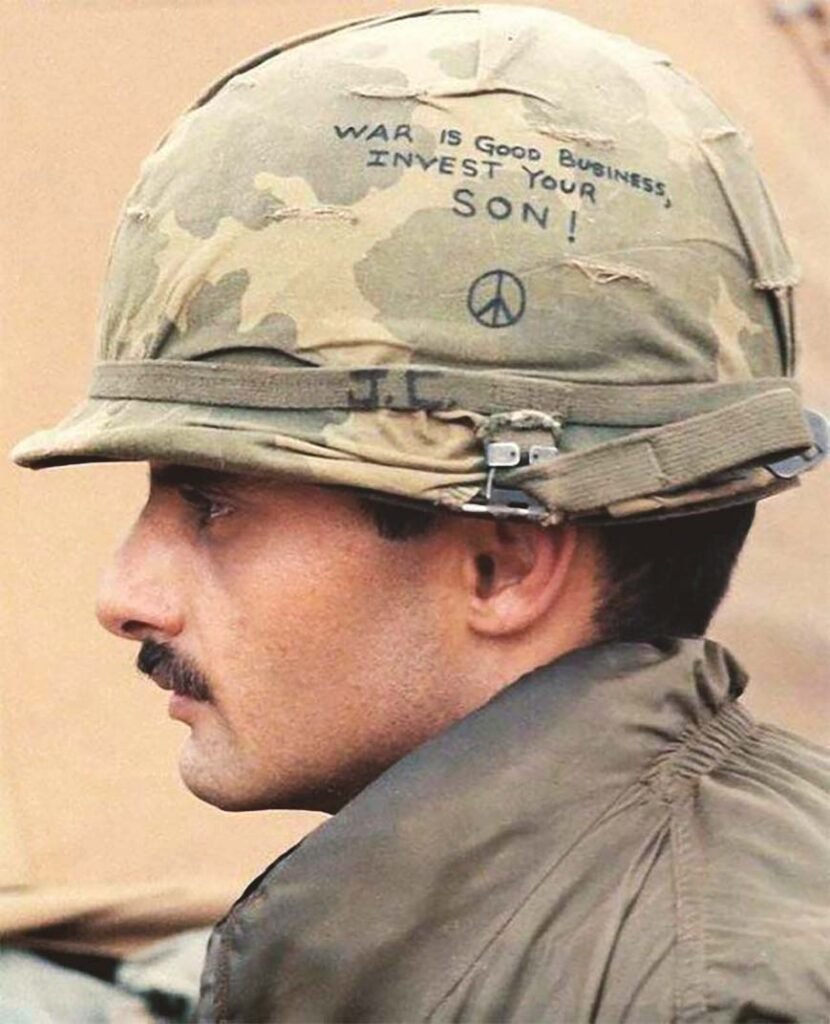
US soldier, date unknown / Image: public domain
By mid-1969, when Nixon started troop withdrawals, morale and discipline in the combat units began to completely unravel. The tactic of ‘search and destroy’ was turned into ‘search and avoid’.
The population back home was turning against the war, and many soldiers were asking themselves: What am I dying for? Why should I sacrifice myself? Graffiti in their restrooms expressed the anger against the military high command and the US politicians. Alcoholism and drug abuse was on the increase.
Eventually, from 1969 onwards, some soldiers started ‘fragging’ officers they deemed too keen for action. If the ranks could not convince their commander to end the ‘mission’, they would roll a fragmentation grenade into the officer’s tent. Historian Richard Gabriel suggested that at least 1,017 officers and NCOs were killed by fragging, and speculated that as many as 20 per cent of the US officers killed in Vietnam may have died at the hands of their own men.[14]
Col. Robert D. Heinl, Jr. a Marine Corps historian, wrote about the breakdown of the US military at that time:
“The morale, discipline and battle-worthiness of the U.S. Armed Forces are, with a few salient exceptions, lower and worse than at any time in this century and possibly in the history of the United States.
“By every conceivable indicator, our Army that now remains in Vietnam is in a state approaching collapse, with individual units avoiding or having refused combat, murdering their officers and non-commissioned officers, drug-ridden, and dispirited where not near mutinous.
“Elsewhere than Vietnam the situation is nearly as serious…
“…All the foregoing facts – and many more dire indicators of the worst kind of military trouble – point to widespread conditions among American Forces in Vietnam that have only been exceeded in this century by the French Army’s Nivelle Mutinies of 1917 and the collapse of the Tsarist armies in 1916 and 1917.”[15]
Labour and the war
Polling revealed that opposition to the war was prevalent across all ages, and was in fact highest amongst the older generations and the least educated.[16] Nevertheless, the bulk of those participating in the anti-war demonstrations tended to be the youth, and students in particular.
In order for the movement to really strike at the imperialist roots of the war, it was necessary for it to draw in the organised working class. This is since it is ultimately only workers who have the ability to seize the levers of the economy from the capitalists, and bring society to a standstill.
After the purging of the left from the labour movement in the late 1940s and 1950s, the AFL (American Federation of Labour) and CIO (Congress of Industrial Organisations) merged into one labour federation. Generally speaking, the union leadership supported the foreign policy of US imperialism and worked hand-in-glove with the CIA.
On 8 May 1970, there was an infamous attack by about 500 ‘hard hats’ in NYC against a demonstration of anti-war students. None of the construction workers who attacked the students were arrested by the police, even though 70 students were injured.
It should be noted that many of the leftist students did not try to put forward their ideas in a way that this layer of the working class would understand. Many of these workers were Second World War veterans, and were angry at seeing the US flag being burned or treated in a disrespectful way.
The NYC Building Trades union organised a demonstration to display ‘love and support for the American flag’ on 20 May. This had about 50,000 workers, many of whom were required by the unions to be there, and some of whom received extra pay to show up. This episode reinforced the stereotype of the ‘conservative American worker’.
There were indeed sections of the working class that were pro-Vietnam War. But polls showed that the less money people earned, the less support there was for the war.[17]
The anger of many union members toward the war did start to have an effect. Soon after the Building Trades’ demonstration, about twelve unions in NYC organised a protest against the war. This included AFSCME (state, county and municipal workers), distributive workers, hospital workers and the textile workers. Although about 25,000 attended, these workers were not paid to attend, and they did this on their own time.
Previously, on 7 May, the United Auto Workers (UAW) leader Walter Reuther decided to publicly oppose the expansion of the war into Cambodia. Unfortunately, he died in an airplane crash two days later, with some suspecting foul play.[18] The UAW was very significant as it was a large and powerful industrial union, which set the pace on union contracts at the time.
There were many strikes during the Vietnam War, especially compared with today. Federal statistics on major work stoppages show the following: in 1969, there were 412 strikes involving more than 1.5 million workers. In 1970 there were 381 stoppages, involving almost 2.5 million workers. In 1971, there were 298 strikes conducted by more than 2.5 million workers. By comparison, in 2023, a recent year in which many workers were on strike, only 35 strikes involving 460,000 workers took place.[19]
These were not political strikes, but economic strikes, mostly over wages. The issue of wages is connected with inflation, as rising prices eat into workers’ standard of living.
Inflation had been climbing in the 1960s and early 1970s, with the Vietnam War a big reason for this. One cause of inflation is when the government spends on the military and armaments. The workers in these industries get wages, but they produce no consumer goods or services. This adds to demand in the economy, but not supply. Presidents Johnson and Nixon both wanted to avoid tax increases for an unpopular war, so they resorted to deficit spending for ‘guns and butter’. Between January 1963 and January 1971, inflation went up 32 per cent.[20]
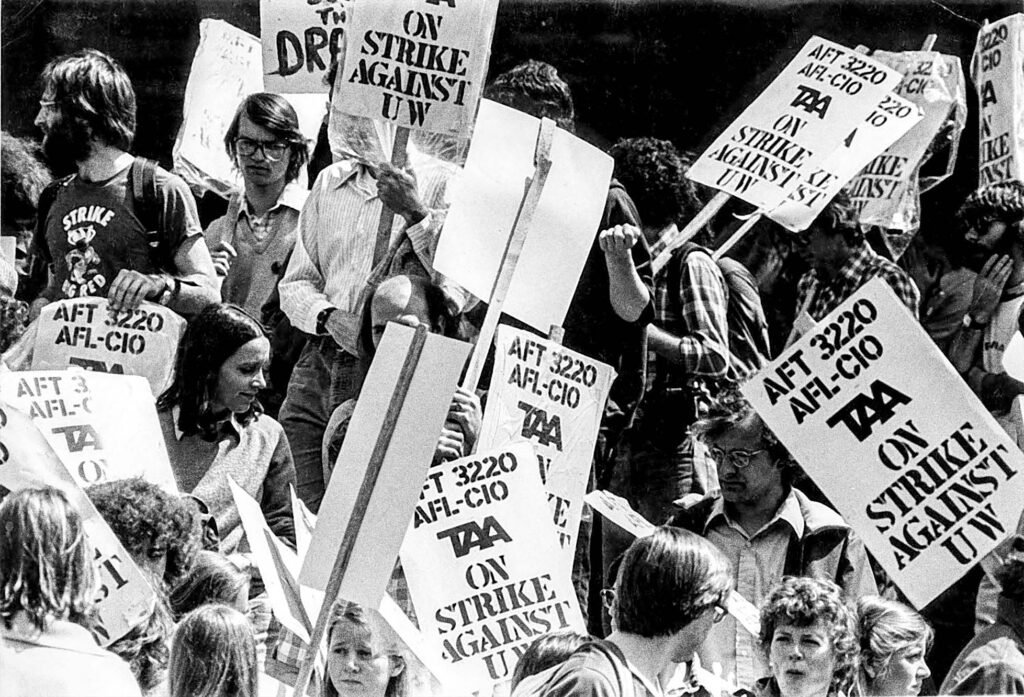
Teaching Assistants Association strike at the University of Wisconsin-Madison in 1970 / Image: public domain
Fear of revolution
There is no question that by the early 1970s, many figures in the ruling class and the state apparatus were becoming worried. There was the increase of strikes, and the economic problems that caused them, particularly inflation. On top of this, there was the civil rights movement and the black revolt, the women’s movement, and the youth ‘counterculture’ in general. There were revolts by prisoners and the rise of the American Indian Movement.
The country was reaching a boiling point, while in Vietnam, the morale of the US troops was collapsing. The prominent Marxist, Ted Grant, commented in the summer of 1972:
“This was the most demoralised army in history. Had there been a strong socialist movement in America, the American capitalists would be facing the socialist revolution under these conditions.”[21]
The movement against the war was becoming a focal point that brought all these various struggles together. This is precisely why the ruling class could see this as a danger that threatened their system.
Whilst compelled to withdraw ground troops, Nixon shifted his strategy to the (at first secret) bombing and invasion of Cambodia in 1969-70, and of Laos in 1971. Allegedly this was to stop supplies and reinforcements traveling on the ‘Ho Chi Minh Trail’, by which Nixon thought he could force North Vietnam to the negotiating table.
This provoked a furious domestic response. Nixon went on television on 30 April 1970 to announce the ground invasion of Cambodia, which set off spontaneous demonstrations over the next few days.
On 4 May, students gathered at Kent State University in Ohio to protest the war. The police claimed the demonstration was ‘illegal’ and the National Guard were called in. Some National Guard soldiers began to fire their rifles, killing four students and wounding many others.
After Kent State, over 4 million students and others protested in some of the largest and most widespread anti-war protests of the period, involving at least 883 campuses across the country.[22], [23] The killings at Kent State were yet another turning point for the consciousness of millions. The entire premise of the war was supposedly to ‘defend democracy’. But here you had students killed and wounded for simply expressing their opposition to the conflict.
Had there been a mass communist party capable of uniting all the struggles of the masses under a socialist programme, the enormous potential of the working class to transform society could have been realised. Tragically, there was no such party established at the time. There was not even the nucleus of such a party.
As a result, the movement began to enter a phase of decline following the dramatic upsurge surrounding the Kent State shootings.
The movement’s ebb
One thing is clear: as the US government began to withdraw substantial amounts of troops from Vietnam, there was a drastic decline in the number of people participating in the anti-war movement.
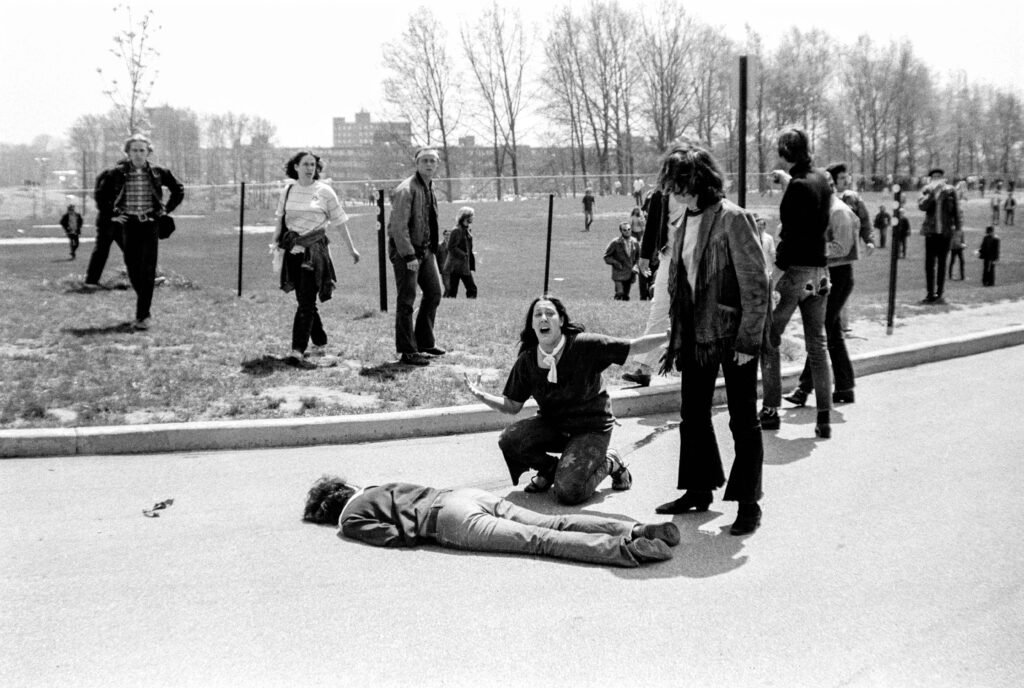
Kent State protester Jeffrey Miller shot dead / Image: public domain
The anti-war movement never had a centralised leadership. It was always made up of different wings. There were liberals, pacifists, religious elements and the ‘Old Left’, as well as the so-called ‘New Left’.
The historical failure of both the Communist Party and the Socialist Workers Party to appeal to the American working class and train the new layers (like the Panthers and the Lords), left a huge vacuum. Thus the petty-bourgeois ‘left’ moved into this space.
SDS, one of the largest organisations of radicalised youth, was itself an eclectic organisation. Its leadership saw itself as part of the New Left, which rejected the ‘Old Left’ of the Stalinists, Trotskyists and Social Democrats. It was influenced by the petty-bourgeois academics of the ‘Frankfurt School’, especially Herbert Marcuse, who argued that the working class was too corrupted by consumer goods and bourgeois propaganda to play any revolutionary role. There was never a serious tendency in SDS that actually studied genuine Marxism, nor did they think to learn from history.
In general, the New Left wrote off the American working class. They saw any revolution as coming from students and other oppressed layers, based on race, sex, age and sexuality. They did not see a reason to build a revolutionary party. They thought that acts of resistance would spur parts of the population to rebellion and revolution. In that sense, they were like the Russian Narodniks of the 1880s, but adapted to 1960s America.
Positioned between the capitalists and the working class, it is in the nature of petty-bourgeois politics to swing from opportunism to ultra-leftism, and back again. With their focus on the ‘individual’, the petty bourgeois tend to look inwards, resulting in movements dividing themselves, rather than concentrating on what can unite them. They look to gimmicks and ‘instant success’, rather than taking a longer view. They tend to substitute their own actions – of a small minority – for those of a mass movement. And they refuse, or are unable, to see that the class with both the potential power and the interest to really change society – the working class – is key.
Without a clear theoretical basis to its programme, SDS split apart in 1969. In the end, many of the people from SDS went into the numerous groups that made up the 1970s sectarian left.
The Black Panthers and the Young Lords broke apart due to vicious state repression, coupled with their own internal weaknesses. These parties started with a few people and grew quickly. The leadership was improvised and included an eclectic mix of ideas. Some of their activity was about party building, whilst some involved running social-service programmes like providing free breakfasts to children in the neighbourhoods. Inevitably, disagreements developed. These were not handled in a way to organise discussions to raise the theoretical level of the membership, and therefore led to demoralising fights and splits.
The anti-war movement itself was mostly organised as a ‘one-issue’ coalition. Much of this stemmed from the leaders’ analysis of the war. Did they see the war as the necessary result of imperialism? Or were they, like many liberals, only against the war because the US was losing it?
The movement only made ties with the organised working class in its last few years, but even then the working class was not its leading force. Some of that can be blamed on the union leaders. But there was no real concerted effort by the anti-war movement’s leaders to appeal to rank-and-file workers, to support union strikes, and tie the issues together, especially on the question of inflation.
Although it was the working-class youth that did the bulk of the fighting in Vietnam, the New Left remained hostile toward the working class, thus severely restricting the movement.
Failure of leadership
A ceasefire took effect on 28 January 1973, by which point nearly all the US combat troops had been withdrawn. Following this, the South Vietnamese comparador regime continued to lose support, until it collapsed in 1975.
The scenes of the helicopters on the roof of the US embassy and the pictures of the helicopters and other equipment being thrown into the ocean off US aircraft carriers made it clear that the mighty colossus of US imperialism had suffered a major defeat. It was a remarkable moment in history, which had a profound impact on society in general, shaking many illusions that the population had in the ruling institutions.
The final stage of the Vietnam War coincided with the end of the post-war boom. With the worldwide crisis of capitalism hitting in 1973, American workers were now going to experience the capitalist class attacking their wages, benefits and working conditions, for decades to come.
If there had been revolutionary leadership, the movement against the Vietnam War would have linked up with the working class and the civil rights movement and helped to forge a real workers’ party. As both the war and the movement came to an end, revolutionary leadership could have re-directed the struggle to the battle for jobs, and against giving concessions to the bosses. It is therefore necessary to consider why such a leadership never emerged.

SDS’ New Left Notes, Vol. 4, No. 24, 8 July 1969 / Image: public domain
The Communist Party USA (CPUSA) was the largest group on the American Left from the early 1920s. In 1928, Stalinism took hold of the party. Under Stalinist leadership, it adopted opportunist politics for the most part from 1936 onward. The party lost many of its members in 1956 because of two events: the Hungarian Revolution of 1956, which was suppressed with Soviet troops; and Khrushchev’s revelations about Stalin’s reign of terror.
In the 1960s, the CPUSA played a lamentable role in terms of the anti-war movement. They continued to tail-end the Democrats – at least the ‘anti-war’ Democrats. They did not call for US troops to be removed at once, but for the US Government to negotiate with the Vietnamese.
The main alternative to the Stalinist CPUSA was the Socialist Workers’ Party (SWP). After Trotsky was exiled from the USSR in the late 1920s, he tried his best to educate a new layer of Marxist cadres. During this period, there was no section of the International Left Opposition (and later the Fourth International) that received more help from Trotsky than the American section, which founded the SWP in 1938.
The leading American cadres however, were never able to grasp the dialectical method of Marxism, and apply it to their analysis of perspectives and party building. After Trotsky was assassinated in 1940, there was nobody that the leadership would listen to who could guide them on the correct path when they made mistakes.
The mechanical and ultimately non-Marxist approach of the SWP led them to miss opportunities during and after the Second World War. The postwar period was certainly a tough period for the revolutionary left in all the advanced capitalist countries, but especially in America. The task was to educate cadres, and then take advantage of new openings which would eventually come their way, as they clearly did in the 1960s with the civil rights and anti-war movements. The SWP did take advantage of these opportunities to some extent, but lacking the necessary theoretical compass, they bent in an opportunist direction.
Building the movement or a revolutionary party?
The SWP’s strategy towards the Vietnam War was basically built on looking for shortcuts to build their party, and accepting a reformist approach towards the war. The SWP completely abandoned a sense of proportion. Its leaders saw the party’s role as building the anti-war movement to a point large enough that it could supposedly force the withdrawal of the US military. Apparently, after this stage, they could then take up the struggle for socialism.
It seems they assumed that the building of the party would be an automatic result of this successful movement. Their emphasis was on building the movement, not building the party and training Marxist cadres. The ‘training’ that the new members were getting was simply in how to build big demonstrations.
The SWP was the dominant force in the Student Mobilisation Committee to End the War in Vietnam, especially since 1967. This committee organised many local and national demonstrations. The problem is that the main push was to get as many people to the demonstrations, using the common denominator of ‘Out Now’.
SWP leader Fred Halstead justified their approach in his book, Out Now:
“The SWP upheld the autonomy of the anti-war movement as a mass force. […] The movement was a united front of a special type, not between mass organisations of the working class for a concrete set of demands, but between diverse and multiclass elements whose sole bond of unity was to oppose the war. It had to confine itself to implementing actions around that central purpose in order to hold together.”[24] (Our emphasis)
But whilst its members ran around to get large turnouts on demonstrations, who from the party was making the political arguments against capitalism in general? Namely, that even if the war ended, unless the working class took power, US imperialism would still exist and there would be more such wars. And that in order for the workers to come to power, they need a party, and this party must be built.
Although the SWP leadership might have said that they agree with all of this, it was not how they trained and deployed their people. The reason for this is if too many comrades made the case for a workers’ struggle against imperialism, it would have worked against the multi-class coalition – this ‘united front of a special type’ – by pushing away the pro-capitalist elements.
This whole approach shows how powerful pragmatism and empiricism was in the SWP leadership. They wanted to focus on the here and now: stop the war. The major focus, however, should have been on how to best build the party, and to win over a larger section of the movement to a revolutionary perspective and programme.
Along with this opportunism, the SWP had a sectarian approach toward SDS. Why would communists not enter SDS when it was growing? Why not try and win over some of these radicalised students? The SDS was wide open with youth looking for answers. Indeed, the Maoist sectarian group, the Progressive Labour Party, ended up winning many of these students. But given the inability of their programme to connect with workers in the USA, the potential of these students was wasted.
The SWP grew from their intervention in the movement against the Vietnam War, but the basis of recruitment was quite low. In the end, what was achieved? In 1959, the SWP had about 600 members in 12 different cities, with approximately 100 each in NYC and Los Angeles.[25] In 1977, eighteen years later, they had about 1,760 members in more than 50 cities, with 2,000 in their youth organisation, some of whom were members of the party, with others as periphery.[26] This was the high point for the SWP.
Had they taken a different approach, the SWP might have grown even larger, given the opportunities that emerged. Shortly after 1977, the SWP went into a period of stagnation, and then a period of sharp decline with a spiral of splits and expulsions.
What is clear is that they built the party primarily on mobilising to stop the war, and did not properly educate its new members as Marxist cadres. The SWP published many books, but there were no major efforts to make sure the recruits or older members actually read them. We can see this in how quickly the SWP fell apart in the early 1980s.
The task of communists
In a broad movement such as an anti-war movement, it is clear that there are various political groupings representing different classes and layers in society. The role of Marxists is to intervene in such movements and connect them to the working class. It is also to bring the issues of the war to the working class. The method of intervention is to shine a light on the root causes of war, and explain that it is only the working class in power that can lead to a socialist world, which is the only basis for lasting peace.
Once the split with President Johnson began in 1968, the anti-war Democrats tried to co-opt the movement. Communists should have put forward the demand that the anti-war movement should not fall for that trap, and that it should run candidates independently. The movement should have called on the trade unions to break from the Democrats and build a labour party. Even if a wing of the anti-war movement did not agree to this, such an approach would have opened up more support for the communists and helped connect the movement with the working class.
It was clear that SDS gained the largest share of radicalised youth, many of whom were looking for a way forward and open to the ideas of revolutionary communism. It was not a question of winning over the entire SDS, but of recruiting the best elements.
It was absolutely correct for communists to participate in the anti-war movement and to help build it. However, this needed to be done without watering down their ideas or hiding their banner. Revolutionary consciousness does not develop in a linear manner; under certain conditions, it can catch up with a bang. Putting forward the ideas in a clear and bold way can gain much more than if done so in a hesitant, half-hearted fashion.
A correct approach by a small number of genuine Marxists in 1964 and after could have created a much larger force with which to build a mass communist party in the US today. Ultimately, however, the SWP was not in a politically healthy condition to be able to do this.
Our tasks today
We cannot just copy and paste from history onto the conditions of today, but we can learn lessons from the past and skilfully adapt them to today’s conditions.
Teaching Assistants Association strike at the University of Wisconsin-Madison in 1970 / Image: public domain
The bourgeoisie have learned lessons from the experience of Vietnam. They removed military conscription in 1973, and never brought it back, even during the wars in Iraq and Afghanistan. They have understood that if they did this it could lead to a repeat of 1965 to 1972, but on a much higher level.
Wars will continue, so long as capitalism exists. Inevitably, some of these will produce mass anti-war movements, as Israel’s genocide against the Palestinians has shown. Communists link the oppression of the Palestinians to capitalism and US imperialism. The path of their liberation is along the road of the world socialist revolution.
The most serious of these youths have started to draw revolutionary conclusions, and we should expect larger layers to look toward communist ideas. Communists who learn the lessons of the past will be more prepared to gain from these present and future opportunities to build the party into a mass force which can lead the working class to victory worldwide.
More Stories
What makes Marxism scientific? – a scientific enquiry
The global rebellion of youth and workers and the war frenzy of the ruling class
Build the 20 November youth strike! Down with militarism! Down with capitalism!