“There is no royal road to science, and only those who do not dread the fatiguing climb of its steep paths have a chance of gaining its luminous summits.”
– Karl Marx, Preface to the French edition of Capital.[1]
[We publish here the editorial of issue 55 of ‘In Defence of Marxism’ magazine – the quarterly theoretical journal of the Revolutionary Communist International. Get your copy now!]
In preparing the present issue, a comrade asked the deceptively simple question: what makes Marxism scientific? The reader who is acquainted with Marxist literature may already have the answer ready in mind. But as Hegel pointed out: what is familiar and generally known, on account of being generally known, is not really known.
What do we mean by this? If we are looking to understand something deeply we cannot anticipate an answer; nor can we presume that our method is sound.
We must proceed systematically to investigate our subject on its own account, and in doing so to show how it necessarily unfolds. That is the scientific method of Marxism. And that is the path we will take. Let us begin.
The claim
In order to answer our question, we will start from the simplest and most immediate form of answer. Ask any Marxist to draw up a list of reasons why Marxism is scientific. What they would come up with would most likely be something like this:
- Objectivity: There is one world, the material world, which exists independently of human beings. Human beings are products of nature and our ideas are, in the last analysis, a reflection of the material world.
- Lawfulness: This material world, including human society, is lawful and by interacting with it we can discover its laws.
- Practice: By understanding the laws of society and nature, we can change the world for our purposes. It is ultimately also this practice that is the proof of our ideas.
These are the fundamental scientific principles of Marxism. And they would apply not just to Marxism, but to any serious science. And as such they are absolutely correct.
But we must halt here for a moment. Can we really be satisfied with this answer? What does it actually tell us and on what grounds does it justify itself?
A claim, without an explanation, explains nothing. This statement is so obvious it would seem absurd to say it. And yet it is not uncommon to hear Marxists, with every intention of defending Marxism, pronounce a series of general statements and slogans which are absolutely true and yet which explain absolutely nothing.
A mere claim of being scientific, and a list of reasons, is important information – but it is certainly no proof. Why this list and not another? Where did it arise from and how is it used? If we want to understand why Marxism is scientific, our list must be proven and explained, not claimed and asserted.
The method
Of course, Marxism is more than a claim or an arbitrary list of principles. It is, first and foremost, a method. And method is essential to science. Marxism stands for the most consistent and conscious pursuit of the scientific principles that we have explained above. It is this that gives our doctrine its peerless advantage.
Let us take an example of why the method matters. In what goes for social and political sciences today, it is not uncommon to hear talk about what ‘should’ be. What the world should look like. Hunger should not exist, and capitalists should place the interests of humanity above their own. Few people would disagree with these statements.
Anti-poverty charities incessantly plead that the ruling class should redistribute agricultural surpluses because, as they correctly point out, the world produces enough food for ten billion people. Yet this valiant wish immediately comes crashing against the wall of reality: under capitalism, food is produced as a commodity for profit, not to feed human beings. If a starving population cannot pay, the laws of the market dictate that surplus food be destroyed to protect prices rather than given away.
In spite of all the well-meaning moral explanations of what ‘should’ be, little of it actually comes to fruition. The campaign for what ‘should’ be becomes a campaign of sowing illusions in the possibility of reforming the capitalist system, thereby turning into its opposite: from an idea that fights general hunger and destitution, to an idea that perpetuates the very system which causes it.
The ‘should’ bases itself on the subjective wishes of individuals rather than on the objective world; it ignores the laws by which that world moves; and so in practice it defeats its own purpose. It fails, in other words, on all three counts of our list.
“The Marxist doctrine is omnipotent because it is true”, Lenin wrote.[2] The force of this lies in the fact that Marxism rests not on what should happen, but on what is happening and why. Only by understanding phenomena objectively – as they are, regardless of our wishes – and grasping the laws and dynamics which bring them about, can we change them.
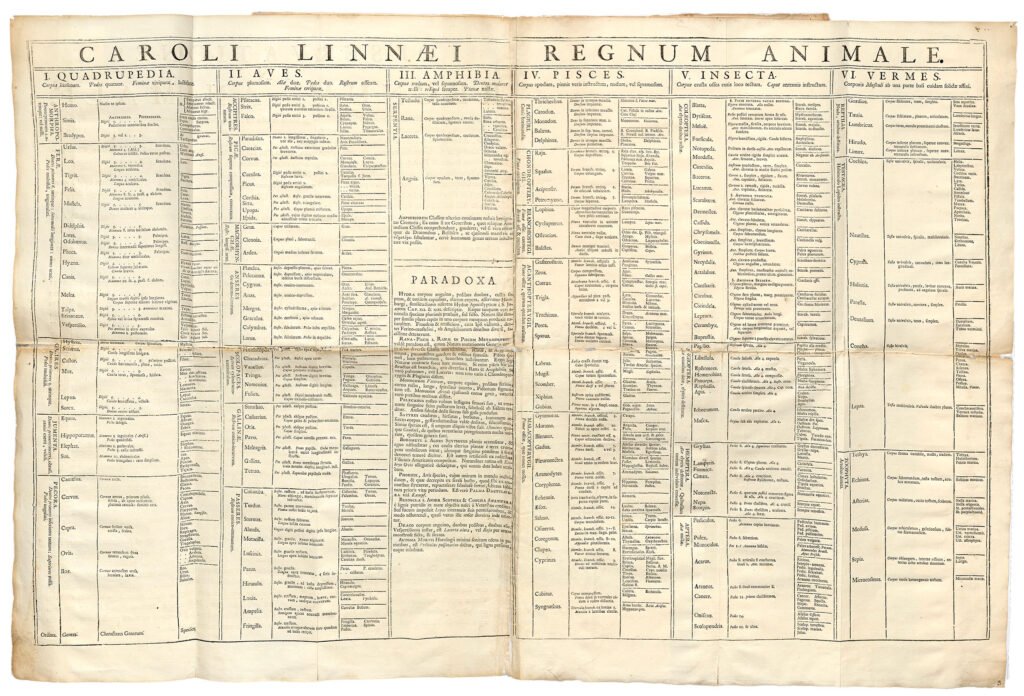
Part of Carl Linnaeus’s Table of the Animal Kingdom from his Systema Naturae / Image: public domain
To have a conscious method of enquiry is of the highest importance, because if you look in the wrong place, you will find the wrong answer.
Nevertheless, a method stated in the abstract is still only an intention and a promise. A serious person would be justified in asking where it comes from, what it can produce, and how. To say that the scientific principles of Marxism are our method is a deeper answer than having merely made a bare claim of them – but it is not yet a proof.
The result
At this point, an astute reader would object that our method – based on the principles of objectivity, lawfulness and practice – is not just an arbitrary set of ideas. It is itself the result of a long process of scientific enquiry into nature and human society.
Marx and Engels did not see their ideas as a rupture with everything that came before, conjured out of nothing, but as building on the achievements of previous generations, as explained in Josh Holroyd and Jérôme Metellus’ article ‘How Marx became a Marxist’ in this issue.
The scientific method itself was derived through hundreds of thousands of years of trial and error, from the practical experience of early societies to the systematic work of countless schools of thought, each building on the last. It is through this process that men and women arrived at the idea that the world exists independently of them, that it has its own lawfulness, and that by grasping these laws we can use them to our benefit.
Basing themselves on the scientific revolutions which accompanied the rise of capitalism, Marx and Engels were able to develop these conclusions more sharply than anyone before them, and to apply them successfully to human society itself.
The scientific principles of Marxism – objectivity, lawfulness and practice – are not merely an intention or a starting point, but a result: the most general result of the history of science. This imbues them with the entire experience of humanity.
That is no secondary matter. A traveller setting off on a journey might tell us what they will experience and how they intend to go about it. But should the same person come back from the journey and tell us the lessons they drew, their words would carry an entirely different weight – even if they said the exact same thing as when they originally set off.
We must however still admit that a bare stating of a result does not explain it to us. In fact, the result taken in isolation gives us little information about our subject matter. Where is the proof for our principles? By which means did we arrive at them and what are their connections?
In Douglas Adams’ The Hitchhiker’s Guide to the Galaxy, a supercomputer works for 7.5 million years to find the “answer to the ultimate question of life, the universe, and everything”. The answer it comes up with is “42”, which bewilders the computer’s creators’ descendants and drives them on a mad mission to establish what the question was and how it arrived at the result.
The enquiry
Consider the history of science and its method, taking biology as our example. Today the origins of science are often obscured, as though it sprang fully formed from the heads of would-be scientists. This ignores the most crucial fact of all: that science arose out of the practical needs of social production. Astronomy and mathematics, the first sciences, grew directly out of agriculture, navigation and the building of large-scale infrastructure.
Biology did not at first exist as a special science, but it was already latent in the practice of early societies. Without the slightest awareness of Darwin’s theory of evolution, early humans used the principle of selection to breed wolves into dogs for hunting and for protection. Later on, with the advent of agricultural societies, wild grasses were cultivated into wheat, rice, millet and maize; goats, sheep, cattle and pigs were domesticated for meat, milk, hides, wool and manure, and eventually harnessed to the plough.
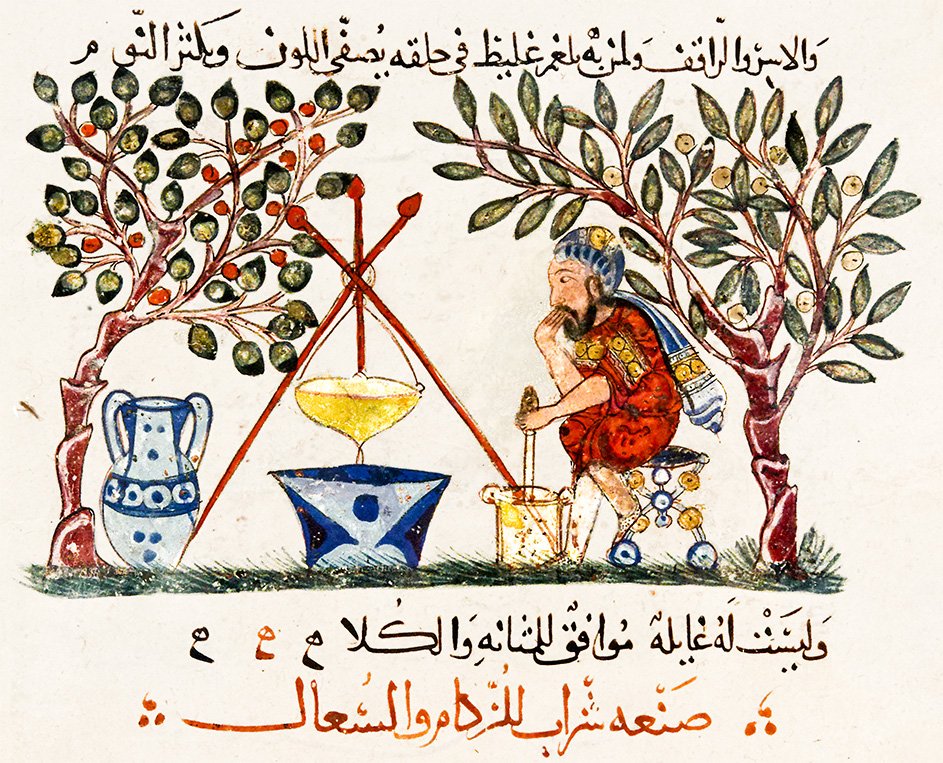
Physician preparing an elixir, from a 1224 AD Arabic manuscript of Dioscorides’ De Materia Medica / Image: public domain
Astonishing ideas for their time but brilliant speculation all the same, resting on limited individual observation, with no way of being developed further. Before the underlying laws of biology could be uncovered, its facts had first to be collected and organised.
Aristotle, the father of biology, described some 500 animal species, dissecting many of them; his pupil Theophrastus did the same for plants; Dioscorides, a surgeon with the Roman legions, catalogued 600 medicinal herbs in a handbook still in use fifteen centuries later. Collection, dissection and classification remained the primary business of biology for some two thousand years.
With the rise of capitalism the sciences received a powerful impetus. The network of universities and scientific societies grew, and world trade brought a flood of new species and specimens within reach of European scientists.
In the 18th century, the Swedish botanist and zoologist Carl Linnaeus brought order to the mountains of new empirical knowledge by introducing the modern system of animal and plant classification. In his Species Plantarum and Systema Naturae he grouped all living things into a hierarchical structure based on shared physical characteristics. He originally divided all nature into three kingdoms (Animals, Plants, Minerals) and broke each of these down into class, order, genus and species.
This was the crowning achievement of two thousand years of accumulated knowledge. Most importantly, it provided the material for the beginning of a truly scientific study of life as a whole.
While a major step forward, Linnaeus’s system was rigid. Life was presented as a permanent grid of distinct, divinely ordered categories where every organism occupied an unalterable slot, its name assigned entirely on the basis of surface anatomical traits. An external classification was necessary before the inner connections of the species and their traits could be understood and explained. But once achieved, this form of classification became a fetter on the further development of biology.
The way out came from Charles Darwin who, on his voyage aboard the Beagle, discovered great variety within the species he encountered: forms that diverged from their ‘ordained’ place in the old classifications and spanned what were believed to be fixed boundaries.
On the basis of long years of observation, experiment and study, he developed his theory of evolution, which states that all life evolves through a process called natural selection, driven by the struggle for survival. His magnum opus, On the Origin of Species, starts where the first civilisations – and our own account – started: with domestication – and shows that what the breeder does by choice, nature does by necessity.
Darwin’s theory rests on three simple facts. First, living things vary: no two members of a species are exactly alike. Second, some of this variation is passed on to their offspring. Third, more are born than can possibly survive, so most die before they reproduce. It follows that the ones which survive will tend to be those whose variations happen to suit the conditions they live in. They pass those traits on, and in this manner we see the evolution of species, the rise of new ones better able to adapt to their conditions and the demise of those that cannot.
Linnaeus’ categories rested on external traits with no proven inner connection. Darwin supplied it by proving that all living things fall into a nested order of groups related by common descent.
Rather than a preordained fixed structure, what appeared was the ‘Tree of Life’: organisms in permanent transition, a historical process developing according to its own laws. Laws which were now being revealed to us.
Biology ceased to be a list of names and became a science of objective laws.
Like all natural laws, the law of evolution does not stand above nature as a decree; it is nothing but the manner in which living things persist and reproduce within their conditions of existence. It is the objective process itself.
The impact of Darwin’s discovery cannot be overstated. From agriculture to medicine, genetics, neuroscience and psychology, to name only a few, the theory and its later refinements laid the basis for enormous advances in production and science. In practice, the world over, in every new plant-breeding programme and every vaccine developed, the theory is proven anew every day.
What we have seen is not only the evolution of life, but the evolution of science itself. Before biology was a science proper, it was as a component part of primitive agriculture, resting on simple techniques honed from generation to generation.
As a science, it began with a long period of dissection and classification, before it could rise to be a discipline dealing with the objective laws of nature.
At every stage, it was practical experience that pushed it forward – and so it is with every science. With each advance, what is subjective and accidental falls away, and what is lawful and objective takes centre stage.
Thus we see the unfolding of the basic principles of scientific enquiry as a result of the process of science itself.
The evolution of mankind
From the foregoing a reader could accept that science embraces practice, lawfulness and objectivity, but still deny that this reality is material. What about human society and, above all, consciousness? Indeed, there are some scientists who claim that consciousness determines reality itself.
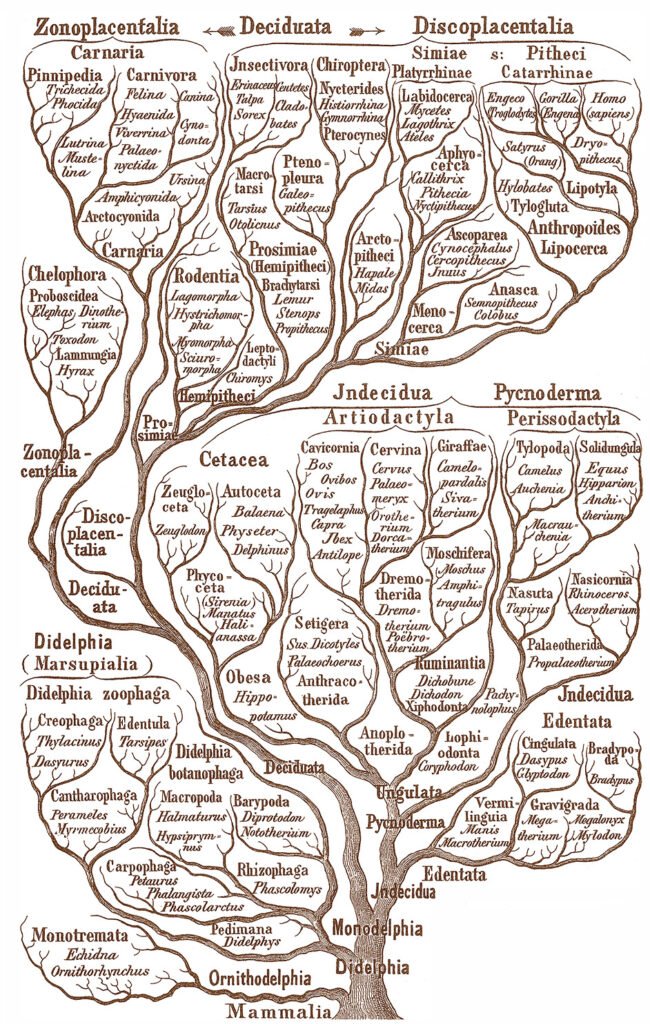
Diagram of mammalian evolution by Ernst Haeckel, 1866 / Image: public domain
Where does humanity fit in the history of life? We have already established that the struggle for survival is the driving force of evolution. The rise and fall of species is determined by their ability to adapt to their environment, extract nourishment and to maintain stability.
Among the countless directions this process has taken, one led toward ever higher levels of sensitivity and, eventually, consciousness. From the first sensitive cells, producing reflex movements at physical contact; through the gathering of scattered nerve cells into the first nervous systems; to the developed brains of mammals, with a degree of consciousness – until, finally, we arrive at mankind.
For centuries, religion presented humanity as the creation of a god, standing above the animal kingdom and its laws. Darwin’s theory once and for all brought humanity back down to Earth, to its rightful place. It, too, is subject to the law of evolution.
But saying this does not tell us how this takes place. Let us not forget that the same law gives the elephant its large flappy ears. The development of human society cannot be deduced from an abstraction; it must be traced concretely on its own terrain, which differs profoundly from that of any other species.
Darwin’s followers held that a large brain and superior intellect evolved first, allowing early humans to learn to walk upright and use tools. This view undoubtedly reflects the idealist prejudices of their era. In his masterpiece The Part Played by Labour in the Transition from Ape to Man, however, Friedrich Engels argued the exact opposite. For Engels, physical interaction with nature came first, and human intelligence was its consequence.
Darwin’s followers held that a large brain and superior intellect evolved first, allowing early humans to learn to walk upright and use tools. This view undoubtedly reflects the idealist prejudices of their era. In his masterpiece The Part Played by Labour in the Transition from Ape to Man, however, Friedrich Engels argued the exact opposite. For Engels, physical interaction with nature came first, and human intelligence was its consequence.
This process started with bipedalism. As our ancestors moved out of the trees and onto open plains, walking upright freed their hands for something entirely new: labour. As they began crafting tools, an evolutionary dynamic was set in motion.
Tool-making required cooperation. This social necessity drove the evolution of speech, transforming the primitive larynx to allow articulate language. Along with dexterous hands, communication acted as a stimulus on the brain, which underwent a massive growth spurt. Human intelligence did not create the civilised world; our physical engagement with the world created human intelligence.
Ignored by mainstream anthropology for a century, Engels’ sequence of human development has been vindicated by the fossil record: the australopithecines walked upright with brains barely larger than a chimpanzee’s, and bipedalism preceded the expansion of the brain by millions of years.
Before Marx and Engels, history was presented as the story of great men, the accidental acts of countless individuals or that of divine intervention. They showed that human society, like the rest of nature, has its own laws, which act beyond the will of any individual: it is not the consciousness of men that determines their being, but their social being that determines their consciousness. These are laws which, once understood, become invaluable to anyone who wishes to change the world for the better.
Like Darwin, Marx traced the law of human development back to the production and reproduction of life itself: before human beings can engage in art, culture or politics, they must eat, drink, and have shelter and clothing. It is on this terrain – the social production of the necessities of life – that the history of society proper unfolds. This is covered in more detail in Adam Booth’s article in this issue: ‘The origins of Marxist economics’.
In producing, human beings develop tools, techniques, skills and knowledge, also called the productive forces. To use these we must enter into definite relations with one another; relations independent of our will: neither master nor slave can stand above slave society.
It is on the foundation of the relations of production that the legal and political superstructure of society rises along with social, cultural and intellectual life in general. The productive forces, however, do not stand still. And at a certain stage in their development, they will inevitably come into conflict with the existing relations of production, which turn from forms of development into fetters. Then, as Marx explained, begins the epoch of social revolution.
What is science?
Marx and Engels demonstrated that humanity is a product of nature and that like the rest of nature, it is governed by its own objective laws of development. The human mind is nothing but matter organised in a particular way and that our thoughts, in the last analysis, are nothing but a reflection of our social production.
In Capital we read that:
“Labour is, first of all, a process between man and nature, a process by which man, through his own actions, mediates, regulates and controls the metabolism between himself and nature. We are not dealing here with those first instinctive forms of labour which remain on the animal level. […] A spider conducts operations which resemble those of the weaver, and a bee would put many a human architect to shame by the construction of its honeycomb cells. But what distinguishes the worst architect from the best of bees is that the architect builds the cell in his mind before he constructs it in wax. At the end of every labour process, a result emerges which had already been conceived by the worker at the beginning, hence already existed ideally.”[3]
In these lines, the veil that for thousands of years shrouded the understanding of the human mind begins to lift. Labour created the mind and drives its advance; the mind, in its turn, guides and organises labour.
In human beings, life is no longer reacting to nature instinctively, but consciously manipulating it, learning the lessons of its interactions and reapplying them. Through language we share these lessons and pass them on from human to human and from generation to generation.
The advantage that this gives our species is enormous. Human knowledge is not an individual process, but a social one. As the productive forces of humanity developed, so did its ideas. Science is the highest form of this: the systematic, social production of knowledge.
Thought arises from practice. It is also in practice that it is applied and tested. Through this process of distillation each forward step of science has banished speculation, superstition and god from one sphere after another. What has appeared in its place is an ever clearer objective picture of nature, explained by nature itself, driven by its own laws. Naturally therefore, these laws must become the main focus of any scientific enquiry.
A living science
The truth is concrete, Hegel explained. To be concrete means to be an organic whole. To truly understand something we must not just list its component parts, but also uncover and demonstrate their necessary interconnections and development. It is ultimately here that the proof is to be found.
It is, of course, only natural that the first venture into a new topic involves listing, classifying and, to a certain degree, learning abstract categories and basic concepts by rote. That is the first stage of all science.
But that must be followed by a second stage, a serious study, which requires immersing oneself in the material, surrendering to it, and thereby grasping its real, inner dynamics as they unfold.
The scientific method of Marxism arises out of the development of life itself – in what Marx called mankind’s metabolic exchange with nature. Marxism is the most conscious and consistent expression of that ongoing process. It is a result derived from that process, applied back to it as a method.
Without its application and its result, the method is an empty abstraction. Without a correct method, the enquiry will go astray and not reach a correct result. And the result, the aim of every enquiry, can only stand if it has been based on a correct method and proven through the necessary course of the enquiry itself.
What emerges is the dialectical unity of the Marxist scientific method, its application and result, none of which can stand separately. It is precisely in the necessary interconnection of each link to the others that a science is justified. This is no longer a dead set of rigid principles, but a living concrete science which is deepened with every application.
That is the scientific method of Marxism. Let us begin.
More Stories
The global rebellion of youth and workers and the war frenzy of the ruling class
Build the 20 November youth strike! Down with militarism! Down with capitalism!
Depressed, lonely, anxious ..? You may be suffering from capitalism