White supremacy can seem like the correct term, but it suggests that racism comes from an alliance of all white people
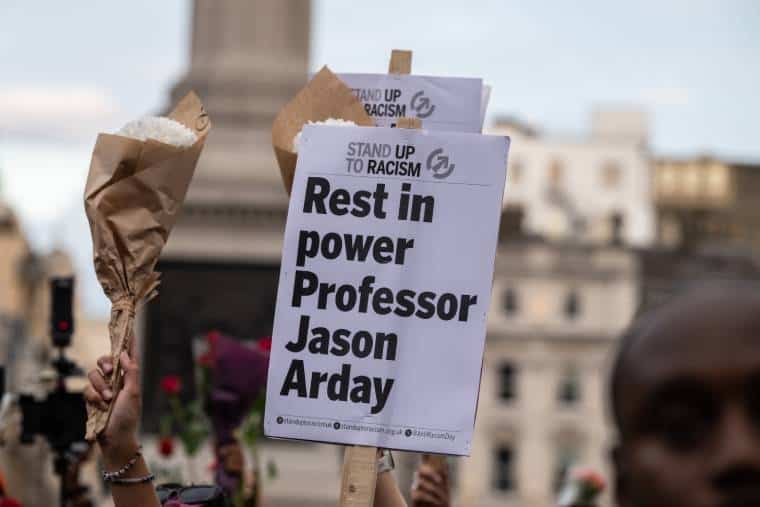
The hounding of Jason Arday has exposed racism in Britain (Photo: Guy Smallman)
The hounding to death of Professor Jason Arday has exposed the depth of racism in Britain.
It goes beyond street violence and includes the sustained campaign of discrimination against a black academic by newspapers.
This has unsurprisingly been described as an example of “white supremacy”.
Looking at the horrors imposed in the name of European civilisation, white supremacy can seem an appropriate term.
But it is limited in explaining or helping us face racism. It suggests that racism comes from an alliance of all white people and is a peculiarly European thing.
Racism, as we understand it, first developed as a justification for enslavement. But it was not accepted evenly.
The concept of “white supremacy” made no sense before then. As late as 1683, European states were threatened by an Ottoman Turkish army that besieged Vienna, then capital of the Holy Roman Empire.
The idea of “white” people was yet to emerge. The first colonists to the Americas described themselves as “European” or “Christian”.
It was the experience of the slave trade that led to the idea of “white” and “black”. The trade started because it was convenient to enslave black people, not because they were seen as naturally inferior.
There was often unity between the black and white poor. It was a series of conflicts that encouraged plantation owners to make rigid distinctions between white and black.
For example, Nathaniel Bacon’s Rebellion of 1676 in the British American colony of Virginia “proclaimed liberty to all servants and negroes”.
In the decades after its defeat, a series of laws were passed removing rights from free black people and those of mixed heritage, making enslavement exclusively for black people and hereditary.
Still, in 1768, at the height of Britain’s domination of the slave trade, a London magistrate complained that, as soon as enslaved people arrived in Britain, “They put themselves on a footing with other servants, become intoxicated with liberty”.
Worst of all, he said, if they escape to London they get the white London “mob on their side” which “makes it not only difficult but dangerous” for slave hunters to recapture them.
The emergence of capitalism was brutal, including the genocidal conquest of the Americas and the enslavement of millions of Africans. These were the worst hit.
But Britain’s colonial occupation of Ireland, the removal of peasants from the land and the murderous conditions in early factories offered no succour to the white poor.
And all white people were not equal.
For instance, in the 1920s the US introduced immigration controls to stop Chinese people coming, but also “Alpine, Mediterranean and Semitic” people. These were seen as inferior whites to the Nordic and Anglo-Saxon races.
A vile anti-migrant journalist Kenneth Roberts wrote in 1922 that immigration must be stopped to avoid “a hybrid race of people as worthless and futile as the good-for-nothing mongrels of Central America and Southeastern Europe.”
These overt kinds of racism became harder to justify after the Nazi horrors of the Second World War. But the fight against racism continues, and is becoming more intense.
Seeing the problem as one of all whites against everyone else allows the rise of black faces in high places as a solution.
An appalling shower of leaders from ethnic minorities in Britain have risen to the top. The likes of Suella Braverman, Rishi Sunak, Priti Patel and Shabana Mahmood have actively encouraged oppression.
Recent struggles have been at their most successful when they have brought working class people together.
Black Lives Matter was at its strongest both in the US and Britain when it expanded to look at the causes of racism and was joined on mass protests by white as well as black people.
The movement for Palestine has shown that when people find agency and self-confidence, people from minorities who felt isolated in Western countries can take leadership roles.
We can expect to see more revolutionary uprisings around the world, whether in Egypt, India, Kenya or Bolivia.
But these countries all have their own ruling classes. Ordinary people can’t rely on any of the rich.
More Stories
IMF report details a financial system with rising risks and vulnerabilities
Bowing to Washington’s pressure, Sri Lanka and India refuse to provide aid to Iranian ships
Marco Rubio declares West must dominate world, praises colonialism, erases history