Lisbon, Portugal
Raposo is an editor of the Portuguese language Marxist web magazine Mudar de Vida (Change of Life) — jornalmudardevida.net — where this article was published on Aug. 9, 2026. Translation: John Catalinotto
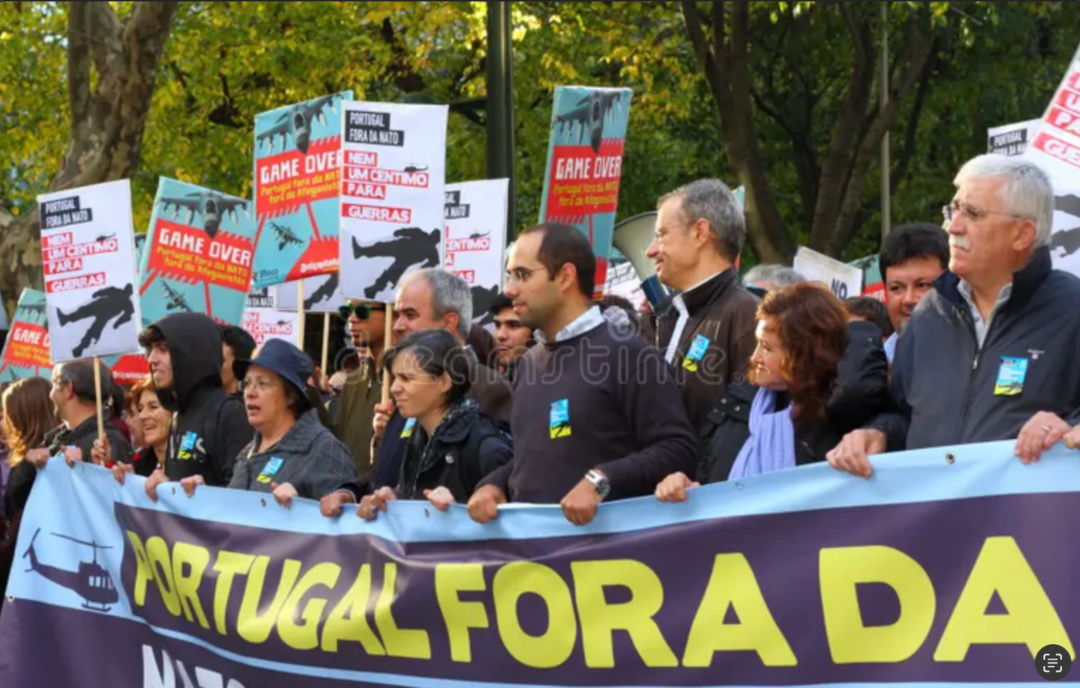
Lisbon, NATO summit protested, 2010. ‘Portugal out of NATO.’
The NATO summit held in July in Türkiye proved that fears of the Alliance’s imminent demise — taking Donald Trump’s bluster at face value — were frankly exaggerated. Instead, what actually happened was a redistribution of the burden among the member states, with a greater share falling on the Europeans; and the reaffirmation of a policy of permanent war against Russia, under the pretext of defending Ukraine and a supposed Russian threat that only leaders in Europe seem to see. But this does not mean that the internal divisions and weaknesses NATO has revealed over nearly five years of war have been eliminated.
The most striking decision made was to commit member states to providing $70 billion (more than 60,500 million euros) annually to Ukraine to sustain the war effort. This amount is in addition to the 90 billion euros that Europe recently approved to send to Kiev just to keep the Ukrainian state apparatus — on the brink of collapse — operational for two years.
War budgets
This means that European countries’ budgets will have to permanently include funding for the war. The confrontation with Russia — which the major European powers have come to defend tooth and nail to counter the diplomatic path initiated by the Trump administration in 2025 — has thus become routine policy, an institutionalization of war by Europe and NATO as a whole.
It is no wonder, judging by the latest U.S. positions, that Donald Trump has agreed to tone down his initial proposals to end the war “within 24 hours” and to blame the conflict on his predecessor, Joe Biden — especially considering that the U.S. military-industrial complex is raking in vast sums of money from Europe’s commitment to defending Volodymyr Zelensky and sacrificing Ukrainian lives. What’s more, the U.S. suffers no direct consequences.
The European Union’s (EU’s) main unifying force, in fact, has become the militarist path it adopted using the war in Ukraine — and, on top of that, the fabricated “Russian threat” — as a pretext. Let us recall the boycott of the [2015] Minsk agreements — explicitly confirmed by senior German and French leaders (Angela Merkel and François Hollande) — which would have prevented the military conflict. Let us also recall the subsequent sabotage — through the direct action of Boris Johnson, then prime minister of Britain, in concert with the Biden administration — of the peace agreement that Ukraine and Russia were on the verge of signing in Istanbul in March and April 2022, just a few weeks into the war.
European disunity
The divisions tearing the EU apart are glaringly obvious, and they render Europe, as a whole, a nonentity, incapable of intervening in international affairs — except when led by the U.S. The 5% of gross domestic product (GDP) that the U.S. has forced NATO members to allocate to military spending is a fee the U.S. charges for its protective umbrella. The sanctions that Europe was forced to impose on Russia, coupled with the destruction of the Nord Stream pipeline, have subjected all countries on the continent to U.S. dictates, pushing them toward economic irrelevance.
Under these conditions — forged by both Biden and Trump, it should be noted — the role of Europeans in NATO is more constrained than ever. This is because, in addition to still lacking significant military capabilities of their own and the military-industrial capacity to do without U.S. production, they no longer even possess the relative economic autonomy they enjoyed just a few years ago.
The announced efforts to establish a “European pillar” of NATO, in this context, amount to nothing more than a redistribution of tasks between Europeans and North Americans within the same web of dependence on Yankee imperialism — a dependence now exacerbated by current circumstances.
Highly selective ‘aid’
To better assess the significance of that additional “aid” to Ukraine decided upon in the Ankara NATO summit, consider the following comparison. Figures published by the Organization for Economic Cooperation and Development for 2024 indicate that funds allocated for economic development across all of Africa totaled 36 billion euros. EU institutions contributed 6.5 billion euros to Africa that year. But they channeled more than 18 billion euros to Ukraine. [1 euro = $1.15]
In other words, a single country received nearly three times as much as an entire continent with 1.6 billion inhabitants — a continent, incidentally, that supplies the bulk of the low-wage labor migration from which European capital benefits and about which, at the same time, the ruling powers complain. This shows that the choices made by European leaders have nothing to do with “development,” but are solely aimed at securing their place within the web of imperialist capital’s interests.
A great deal of cynicism accompanies these so-called choices made by Europeans. In fact, the endemic corruption in Ukraine — of which the government in Kiev and Zelensky himself are both architects and beneficiaries — and the dominance that far-right forces exert over the country’s institutions reveal the unscrupulous nature of the European ruling elites.
While swearing respect for “democracy” and feigning concern for the defense of “Western civilization” (whatever that may be), they are, in fact, paying a hefty fee to the mercenaries on duty to ensure that the policy is followed; and they protect all the Nazi scum that permeates the armed forces and recruitment centers, because they consider it the most useful and suitable force for the kind of war of attrition they intend to perpetuate.
A dubious cohesion
The apparent unity of NATO displayed in Ankara is, in fact, riddled with contradictions. Of NATO’s 30 European members, 23 are also members of the EU. This overlap means that the turmoil within the EU — and there is no shortage of it — inevitably reverberates through NATO’s cohesion.
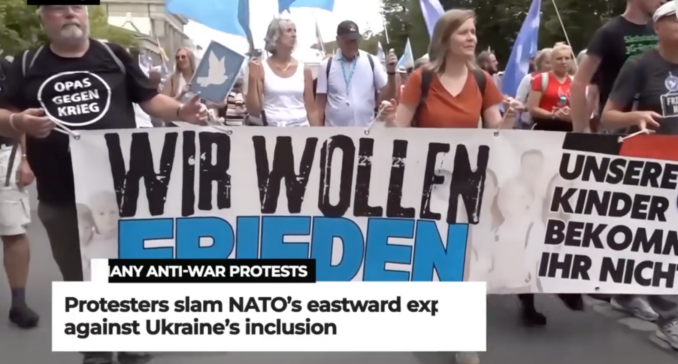
Anti-NATO demonstration, Berlin 2025. Grandparents say ‘We want peace’ and ‘You won’t get our children.’
The scheming by France, Germany and Britain to drive the war in Ukraine and shape NATO’s European face is proof that this “Europe triumvirate” blatantly undermines the EU in order to play a dominant role in NATO and European politics, without having to abide by the EU’s unanimity rules.
The refusal of several Eastern European countries (Slovakia, the Czech Republic, Bulgaria, Romania and even Hungary and Poland) to strictly comply with [EU capital] Brussels’ orders, regarding support for Kiev and sanctions against Russia shows that the EU-NATO framework does not serve all countries equally. The ruling class in each country seeks to defend its own interests as much as possible.
The Spanish government’s resistance to obeying Trump’s dictates during the war against Iran opened a rift in Europe’s usual unanimity, reminiscent of France’s and Germany’s dissent regarding Bush’s war against Iraq in 2003.
The wretched campaign orchestrated — by Italy’s fascist Georgia Meloni and Denmark’s social democrat Mette Frederiksen (!), accompanied by 20 other states — against the Spanish government under the pretext of recent events in Ceuta (of which the current Spanish government was a target!) paints a picture of the Cain-and-Abel-style brotherhood that reigns in the EU.
The distance Türkiye has maintained — both regarding the war in Ukraine (with channels open to Russia) and the war in the Middle East (harshly condemning the Israeli regime) — shows that NATO’s second-largest military power does not always toe the master’s line.
All of this is unfolding against a backdrop of defeat. The plans to defeat Russia in Ukraine have fallen through. Trump’s attempts to end the conflict are an acknowledgment of that defeat (which the Europeans’ maneuvers cannot undo). Plans to force Iran to capitulate have also failed, to the point where the U.S. does not know how to extricate itself gracefully from the quagmire.
The arsenals of NATO and the U.S. — as has now been revealed by an unsuspected source, the Pentagon itself — are depleted. The European and U.S. economies are suffering the repercussions of sanctions and the disruption of global trade flows resulting from the wars they have unleashed. The forces of imperialist capital are proving incapable of controlling the consequences of their actions — which in itself is good news for the peoples of the world.
The source of the billions
Where do the billions that NATO and the EU continually pour into the Ukrainian money pit come from? German Chancellor Frederik Merz said it openly and shamelessly, with the brazenness of a war capo: they come from Europeans’ social benefits, of course; they come from pensions, healthcare and all those “luxuries” to which Europeans have been “spoiled.” The chancellor’s candor is not intended solely for the German public; it is a veritable directive for all countries in the EU and across Europe.
That the capo’s voice is to be heeded is proven by the Portuguese government’s reaction immediately following the Ankara summit. Frankly, the prime minister and the finance minister went public to say what everyone had anticipated: to ensure payment of the funds demanded by NATO, it will be necessary to raise taxes and review the “management of existing spending” — a cryptic phrase for “cutting social benefits.” It was a preliminary testing of public opinion.
The 3.1% of GDP that the government intends to allocate to defense next year will amount to approximately 10 billion euros. To put this in simple terms [in Portugal], that is equivalent to 117 hospitals like the one in Sintra, which opened last summer. It will be easy to see what will happen with the increase to 5%, year after year.
Not a single penny more!
The effects of this war policy (for that is what it is) on the people of Europe, particularly workers, are clear: a deterioration in living conditions and the curtailment of social and political rights.
The link between the choice to wage war, the diversion of investment toward military production, submission to the U.S.-EU-NATO war plans and the attack on living conditions and civil liberties is clear and direct. The implementation of a militaristic rearmament policy — such as the one the EU has put in place — goes hand in hand with the dismantling of the welfare state.
The role of labor unions is crucial, as demonstrated by the strike by Mediterranean dockworkers targeting arms shipments to Israel (in February of this year). And as was highlighted at a meeting of 200 German union activists (in late July, in Würzburg) that denounced the German government’s militarization of the world of work, which will surely spread to the rest of Europe.
It is time for a grassroots campaign against the war and against NATO in which the working class has its own voice. It is their lives, in every sense, that are at stake.
More Stories
IMF report details a financial system with rising risks and vulnerabilities
Bowing to Washington’s pressure, Sri Lanka and India refuse to provide aid to Iranian ships
Marco Rubio declares West must dominate world, praises colonialism, erases history