The reopening of the Yemen front and attempts to link Ukraine to the middle-east war show clearly that escalation not peace is Washington’s aim.
A Nvidia office building in Santa Clara, Calif., May 31, 2023. Jeff Chiu [AP Photo/Jeff Chiu]
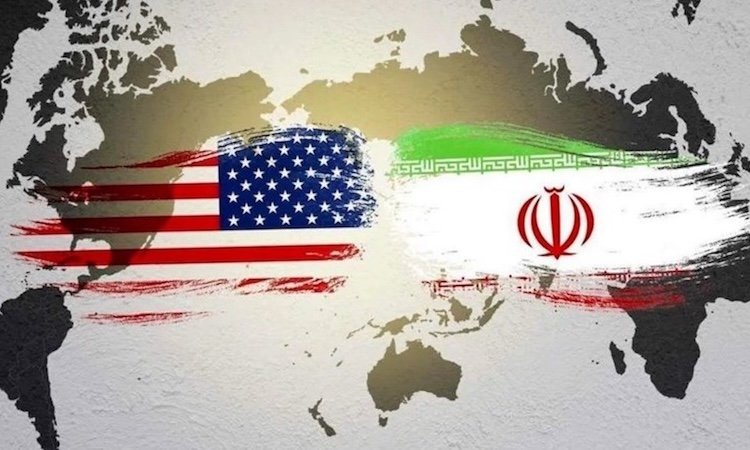
Following their launch of an illegal, aggressive war against Iran on 28 February this year, the US imperialists and their regional Israeli proxies were forced to call a halt after 40 days, retreating ignominiously and earning themselves a respite from Iranian retaliation only by accepting the Islamic Republic’s terms for a ceasefire and peace talks.
In six weeks of barbaric attacks, the aggressors assassinated Iran’s revered revolutionary and religious leader Ayatollah Ali Khamenei, deliberately massacred young schoolchildren and persistently targeted civilians and civilian infrastructure. What they signally failed to do was to provoke the Iranian people into bringing down their own government – the openly stated aim of the White House when the US regime launched this latest military attack, and also when it gave its vocal backing to the Mossad-instigated riots in Tehran and other cities in the last days of 2025.
Not only has the people’s will not been broken by these repeated attempts to destroy their sovereignty; their unity and their determination to resist such attempts has been hugely strengthened. Millions have shown their support for their government and their defiance of US bombers in nightly street demonstrations across the country. The crowds for Ayatollah Khamanei’s last rites were so enormous over five days of national mourning that it is thought by many to have been the largest funeral in history.
Meanwhile, all attempts to degrade Iran’s military defence capabilities have backfired spectacularly. Today, it is not Iran but the USA which finds its missile stockpiles dangerously depleted.
Throughout 2026, the Islamic Republic has replied to attacks launched from US bases in the Gulf with shattering return-fire aimed at degrading and defanging the entire infrastructure of imperialist domination in the region – including US air defences, radar systems, air and naval bases and data centres, as well as military infrastructure across Israel.
With at least 13 bases rendered uninhabitable in the first weeks of fighting and with more following since, US forces have been forced to move back to Israel (1,000km away from Iran), to Europe (eg, to the British and Cypriot bases on Cyprus) and into hotels and office spaces near to their ruined bases in the Gulf countries (servicemen’s family members have been evacuated back to the USA).
Who really uses terrorism and targets civilians?
The use of hotels and offices, while putting local civilians at even greater risk, has not worked out so well for the Americans as they might have hoped. The watching world has been extremely impressed to see how Iranian intelligence has located many of these soldiers and has been able to target them not only by hitting the right hotels, but even by hitting the precise rooms in which they were hiding.
One has only to compare this targeted approach, using pinpoint drones, with the carpet-bombing, terrorising assaults preferred by the USA and its Israeli attack-dogs to understand the nature of the contending forces. Consider the entire residential block that was vaporised by one hundred 2,000lb bunker-buster bombs in Beirut in September 2024.
US president Donald Trump had the nerve to describe this undiscriminating blitzkrieg as a “targeted operation” to assassinate the leadership of the Hezbollah resistance movement. As we wrote at the time: “The one thousand Lebanese civilians killed in this brutal attack were not considered worth a mention by most bourgeois media.” (Hassan Nasrallah, Hezbollah’s legendary leader, 1 November 2024)
Iran has also been working hard to scupper US plans to send in ground troops by destroying much of the base infrastructure along its border with Iraq where the USA and Israel have been training and massing Kurdish militias for decades. (For more detail see Iran’s western frontier: the Kurdish factor in the expanding conflict, Intelbrief from The Soufan Centre, 4 March 2026)
Most Kurdish Iranians have disavowed the continued mis-use of their ethnicity as a second dagger (alongside zionist Israel) at the heart of the middle-eastern peoples’ liberation struggle, choosing instead the path of national Iranian unity in the face of imperialist attempts to split the population along ethnic and confessional lines, the better to break up the country and control its resources.
All of which explains why, instead of ending with a weakened and demilitarised Iran, desperate for peace on any terms, the 40 days of war earlier this year was brought to a close because the USA and Israel were desperate for a respite. The extent of Israeli losses – not only soldiers’ deaths but also the damage and destruction of military, civilian and economic infrastructure – is heavily supressed and goes almost entirely unreported in western media.
What we do know is that the number of IDF troops killed or wounded as they have tried (and failed) to occupy southern Lebanon is far higher than has been admitted to, and that the combined effect of these losses with the degradation of air defence capabilities, military and intelligence bases and other vital infrastructure by Iranian missiles has further exacerbated the societal and economic crisis that the zionist entity was already experiencing after two years of battling Palestinian and Lebanese resistance forces following the launch of operation Al-Aqsa Flood and the genocidal Israeli response.
The result is that Israel today is more fragile and exposed than at any time in its 78-year history, and its society becoming ever more fractured. Many Israelis with the funds and passports to enable their exit have already left, and it is unlikely they will return. Moreover, those leaving are disproportionately those with the kind of professional and technical skills that should make it relatively easy for them to find work elsewhere, and without whose skills (and tax payments) Israeli society will struggle to function.
The USA’s negotiators could only achieve the much-needed ceasefire by agreeing to the terms that had been set by Iran, and a memorandum of understanding (MoU) was signed on that basis – and on the understanding that it would provide the basis for meaningful peace talks. (The war against Iran – pause or cessation? by Ella Rule, Lalkar, 1 July 2026)
MoU: a pause, not an ending to the war
However, substantive peace talks based on the agreed MoU remained a remote and essentially unattainable goal, for the simple reason that the imperialists are not in a position to accept their defeat and walk away. And, while Iran’s leaders are no doubt able to agree to one or two face-saving gestures and some diplomatic phraseology, the essence of any deal will be that it is laying out the terms of imperialist surrender.
As with Nato’s proxy war against Russia in Ukraine, the imperialist bloc is doing everything possible to keep the war front burning, albeit at a reduced pace that their depleted arsenals can maintain, in the hopes that multi-front, hybrid warfare will eventually succeed in wearing down and destroying the targeted nations, whom direct military confrontation has so far failed to beat.
True to their “agreement-incapable” form, having signed the MoU on 17 June, the imperialists began breaching its terms almost immediately.
After three weeks of a fragile hiatus (during which time Israel was in daily violation of the ceasefire agreement, continuing to commit heinous war crimes against the people of Lebanon and Gaza as Iran warned its patience would not last forever), the USA renounced its earlier pledge to accept the new reality in the strait of Hormuz – ie, that all commercial shipping passing through the vital Red Sea chokepoint must now coordinate its passage with Iranian authorities – and tried to force a new route through on the opposite (Omani) side of the strait (thus pulling Oman into the war on the imperialist side).
Having clearly warned that this would be regarded as a breach of the MoU (and therefore an act of war), Iran struck ships engaged in breaking the MoU on 7 July. By 14 July, the US navy had reimposed its blockade of Iranian ports that they had only weeks earlier agreed to lift. It also commenced bombing Iran’s southern port cities (Hormozgan, Bandar Lengeh and Bandar Abbas), launching its attacks from Gulf air bases that remain functional.
While Iran’s ports were the US bombers’ main target, there were reports that other cities and infrastructure in Iran had also come under attack. Sites included a location just by a children’s cancer hospital in Ahvaz (from which all the patients had to be speedily evacuated), a desalination plant in Hormozgan (which left at least 10,000 local residents without water), and the Darhovin nuclear power plant. The bombers also hit at least five bridges.
As ever, the imperialists’ relentless propaganda about how brutal their opponents are turns out to be a projection of their own base criminality. American politicians and media have been crying crocodile tears and accusing Iran of striking civilians and civilian infrastructure, even though the Iranian military has in fact been carefully targeting US and US-aligned military bases and infrastructure in the Gulf – all legitimate targets that have been used to wage an illegal, aggressive war against the people of Iran.
Meanwhile, the imperialists themselves, unable to degrade Iran’s missile programme and put a stop to its return fire, really have been targeting civilians in what amounts to a prolonged and brutal act of collective punishment.
Iran takes ‘zero tolerance’ attitude to US bad faith; Gulf client states feel the heat
Iran’s retaliation to every US provocation has been both justified and legal. Even the US army’s Centcom (middle-eastern headquarters) has admitted that US strikes now draw return fire from Iran within 30 minutes, and that the interval between imperialist attack and Iranian counterstrike is continuing to shrink.
One significant strike hit the USA’s Muwaffaq Salti air base in Jordan, killing at least two American soldiers on 17 July and injuring many more. The Iranian military stated that the strike was in retaliation for the base’s role in attacking the zone of the Ahvaz cancer hospital.
Pentagon and White House spokespeople persistently under-report and manipulate American casualty numbers, with only 18 US service members having been officially admitted as killed and 447 injured. Officials have privately admitted that the real information is being deliberately hidden. (US official: Iran attacks injured ‘far more’ troops than Pentagon admits by Nick Turce, The Intercept, 20 July 2026)
Meanwhile, Bahrain has begun using Sheikh Isa air base – a Bahraini facility that houses imperialist planes and equipment – to shoot down Iranian missiles (ie, to act as an advanced line of air defence for US and Israeli assets). This base is close to the towns of Riffa, Sitra and Manama, whose people are all being put at further risk for the sake of imperialist interests.
No wonder the protest movements of patriotic civilians in Bahrain and Jordan are reaching boiling point! Even supporters of these regimes are becoming uneasy with their countries’ increasingly overt role in the war, recognising that this is the fastest way to goad the people to action and thus bring about the collapse of the already unstable Gulf autocracies.
On 30 July, according to Press TV: “Hundreds of Jordanian politicians, lawyers, academics and civil society figures signed an open letter calling for the withdrawal of US military forces from Jordan, in a rare public challenge to the kingdom’s authorities …
“Ninety-year-old political activist Sufyan al-Tell said he had signed the letter to demonstrate that many Jordanians oppose the government’s close ties with the United States and Israel: ‘We as Jordanian people do not accept the government’s policies or its use of Jordan and its capabilities in one way or another to defend Israel.’
“Jordan hosts around 4,000 US troops and has served as a key hub for the ongoing American military aggression against Iran … Jordan has also played an active role in intercepting Iranian missile and drone attacks targeting the Israeli-occupied territories.” (Hundreds of Jordanian public figures sign letter calling for US troop withdrawal)
Saudi Arabia recklessly reactivates the Yemen front
Three further developments since the ceasefire collapsed are worthy of note. First, on 13 July Saudi Arabia attacked the airport at Sanaa, Yemen, without any provocation whatsoever, and in violation of a four-year ceasefire that brought to an end a decade of open hostilities between the west-backed Saudi invaders and the local Yemeni resistance.
Imperialist media tried to frame the strike as being somehow justified under unilateral western sanctions, saying it was aimed at preventing a sanctioned Iranian plane from bringing back the Yemeni delegation from Ayatollah Khamenei’s funeral. In effect, the airport strike was trying to reinforce the long siege that has been imposed on the Yemeni people and its free government in the north, specifically aiming to cut the Sanaa leadership off from their fellow anti-imperialists in Iran.
It is well-known to all that such an attack as this must have received a green light from the Saudi military’s Anglo-American handlers. No doubt the imperialists hope that by opening multiple fronts, they will be able to stop their enemies from making a unified and concentrated response and coming to each other’s aid. But this calculation has a reverse implication: it is not only the resistant countries that may find their resources stretched, but also the imperialist camp, which is already struggling to maintain the necessary flow of materiel and manpower to the Ukrainian war front.
Moreover, after two years of brave and principled Yemeni action in support of Gaza, the former impunity that the west enjoyed in waging its genocidal war against that nation’s people has been destroyed. People across the region – and, indeed, the world – have been inspired by the strength, dignity and unity of the Ansar Allah-led forces, and war on Yemen’s people will no longer be viewed as a separate sphere of action either by the Yemenis themselves, by the wider Axis of Resistance, or by the progressive peoples of the world.
In response to the Saudi attacks, the national government of Yemen has officially joined the war on the side of Iran, and Saudi Arabia now finds itself jostled into becoming an open belligerent on the US and Israeli side – a move that is likely to have dire economic and political as well as military consequences for the autocracy there.
In response to the Sanaa airport strike, Yemeni drones hit a Saudi airport in Abha, and on 20 July the Sanaa government announced a blockade on all Saudi shipping in the Bab el-Mandeb strait – a further tightening of the oil supply that could have serious consequences for the global economy as well as disastrous ones for the Saudis.
“In June, Saudi Arabian oil exports via the Red Sea averaged roughly four million barrels per day (bpd). In total, about seven percent of the global oil output (7.4 million bpd) transited the critical waterway, according to the maritime intelligence firm Kpler, up from 4.2 million bpd in 2025.
“The Houthis [ie, the Ansar Allah-led Yemeni government in Sanaa] followed their announcement with an email to shippers that, according to Reuters, said: ‘Vessels are banned from loading or discharging cargo at or from any Saudi ports.’ The message went on to threaten that vessels transporting Saudi cargo ‘may be subject to targeting in any location within the operational reach of the Yemeni armed forces’ [ie, in the Red Sea and the Indian Ocean].
“‘The criminal Saudi enemy has continued its unjust and brutal siege on our dear people for nearly 12 years – plundering wealth and imposing a comprehensive blockade on ports and airports by land, sea and air – which has worsened the suffering of our dear people until conditions reached an unbearable level, without any right or justification for doing so,’ Yemeni military spokesman Yahya Saree stated in an announcement of the maritime blockade.” (Houthis announce blockade of Saudi Arabia, ships reroute to avoid Bab-al-Mandeb strait by Bridget Toomey, FDD’s Long War Journal, 22 July 2026)
Days later, Yemeni armed forces hit Aramco oil sites in the Saudi industrial port cities of Jazan and Yanbu with ballistic missiles, cruise missiles and drones. According to Press TV: “Visual evidence, including satellite data and footage circulating widely, showed fires and smoke rising over the targeted facilities, despite Saudi claims of interceptions that Ansarullah has dismissed as a cover-up.” (Ansar Allah: Confused Saudi accusations expose failure after Yemeni strikes on Jizan and Yanbu, 28 July 2026)
Reports suggest that while storage tanks were hit, the processing infrastructure was deliberately avoided – for now. Across the region, resistance forces continue to make it clear that they have the capability to escalate further if the aggressors don’t see sense and back down while they still can.
This is a big factor in their ability to keep the maximum number of people and countries on their side – their ability to show that it is not they who are recklessly endangering the entire global economy and threatening the lives and livelihoods of poor people and developing nations everywhere.
Second, Iraq’s new comprador prime minister Ali al-Zaidi visited his masters in Washington on 14 July, where he agreed to try and disarm resistance groups in Iraq by September and signed $60bn worth of new energy deals.
Another agreement was made to prevent Lebanese resistance groups from using the Iraqi banking system. Meanwhile, a joint Saudi-US strike on Iraqi territory on 28 July killed at least 20 fighters of Iraq’s Hashd Shaabi (Popular Mobilisation Forces or PMF) and injured 32 others.
Whether al-Zaidi will be in a position to deliver on his commitments is extremely doubtful, since the resistance factions in Iraq enjoy strong popular support and have consistently refused to disarm while the USA retains any military or economic hold over their country. Moreover, large masses of the Iraqi people are strongly in support of the Iranian war effort and would very much like to join the war to evict the imperialists and zionists from their region.
The attack on PMF units that are actually recognised as part of the Iraqi national army will only add to the sense of national humiliation that continues to burn in Iraq after two decades of occupation and plunder by western militaries, proxy armies and corporations.
The longer the war on Iran drags on, the more likely it is to expand and the harder it will be for the US and its vassals to keep the lid on the anger of the Arab masses.
Third, following the Israelis’ failure to defeat the Lebanese resistance, President Trump continues to promote the idea that his HTS jihadi death squads in Syria should be sent in as the new frontline attack-dogs against Hezbollah. Stooge-president Abu Muhammad al-Jolani (now known as Ahmed al-Sharaa) appears to have mixed feelings about the wisdom of getting directly involved, but ultimately his regime will do as it is told until the Syrian people remove it.
Finally, on the night of 25/6 July, the Ukrainian junta opened a whole new front by attacking an Iranian ship in the Caspian Sea. Actor-stooge president Volodymyr Zelensky himself publicly announced the attack, in which one sailor is known to have been killed. Iran formally notified Russia of this aggression and urged European countries to hold Ukraine accountable, while reserving its own right to respond directly.
Once more, it must be noted that there is no way the Ukrainians would have or could have carried out this attack without the explicit agreement and cooperation of western – including US – military officials. Could this be a way for the Anglo-American Iran hawks to pull the EU imperialists directly into the middle-eastern front? Or for the European camp to persuade the USA to explicitly join the two fronts?
At this stage, one can only conjecture. What we do know is that Andy Burnham’s opening statements as prime minister leave no room for doubt that the British warmongers are dead set on escalation on all war fronts.
Unprecedented US military losses
Iranian military sources have published a major list of US military assets hit during 15 days of fighting starting on 8 July. In the air operations sector alone: 11 fighter aircraft and helicopters were destroyed or damaged on the ground; 17 reconnaissance and operational drones (eight of them brand new) were hit; an F-15 was destroyed inside its hangar at Muwaffaq Salti air base; one P-8 marine patrol aircraft, one C-17 transport plane, eight aerial refuelling aircraft and four heavy helicopters were all destroyed.
Besides taking out the above-mentioned 43 US aircraft in two weeks, the Iranians also hit seven command-and-control centres, three satellite communication systems, six Patriot air defence radars, three air and maritime surveillance radars, eight early warning radar systems, seven air-missile defence radars, three FPS radar systems, two FPS-117 radars, five long-range radars, two air defence radars and one tactical radar complex, along with six MQ-9 drone hangars, four Himars launch platforms, 12 fuel tanks, four Patriot complexes, an aircraft-carrier refuelling platform and an Amazon AI data centre in Bahrain.
The USA does not report on such losses, of course, since to do so would be to openly admit that the myth of American invincibility and invulnerability is dead, but estimates put the total bill for military losses in this 14-day period alone at a massive $20.6bn. Such losses are unprecedented in the USA’s post-WW2 history.
As this article was being written, the USA had once more stopped its strikes on Iran for several consecutive nights, in what the western media were once again describing as a “pause” in hostilities. Since the imperialists’ objectives have not been met, and they are clearly not going to accept their defeat and walk away with good grace, it behoves us to examine what exactly has pushed Washington into its latest cessation.
On Friday 24 July, joint chiefs of staff chairman General Dan Caine warned President Trump in a White House meeting that interceptor stockpiles had been dangerously depleted. A report from the Centre for Strategic and International Studies (CSIS) estimates that the USA’s Patriot interceptor stockpile has been reduced by 65 percent since 28 February to as few as 759 missiles, warning that a return to all-out war would leave Centcom dangerously exposed.
The report also noted that commanders have been deliberately allowing some missiles through in order to conserve their falling missile stocks. The USA produces 183 of these interceptors a year and it takes around three and a half years from the time a contract is signed for them to be delivered, according to CSIS. (US Patriot interceptor stockpile diminished by some 65 percent during Iran war, think tank estimates by Chris Boccia and Luis Martinez, ABC News, 30 July 2026)
It is clear now that these pauses do not signify a genuine desire to find a peaceful resolution on the part of the imperialists, but only a need to restock and rearm, alongside yet another attempt to achieve through ‘negotiations’ (ie, through diplomatic and economic bullying) what has not been achieved on the battlefield.
Without the vast injection of wealth and resources that victory in one or both of the imperialists’ major war fronts (ie, Russia and/or China), a reboot to the crisis-ridden global capitalist economy is simply impossible. The fronts against Iran, the DPRK, Latin America and the Sahel are seen by imperialists as necessary to the overall success of their plan to bring down their biggest targets and reassert their global hegemony.
Global capitalism – imperialism – in crisis can only hope to survive an overproduction crisis as deep as the present one by means of an orgy of looting on the one hand and massive destruction on the other. Destruction on a scale vast enough to create a surge in demand for all the things that would then need to be reconstructed (as the world experienced in the ‘postwar boom’ of the 1950s).
What is in the firing line is decades’ worth of accumulated wealth – products and means of production, infrastructure, homes, schools, hospitals, bridges, railways, airports, power stations, etc that have been created through the efforts of millions of workers over several generations. Their destruction, and the consequent suffering of the people who have to do without, are ‘necessary’ for global capitalism – to bring back demand to the market and therefore also to bring back profitability, until the next crisis comes around, of course.
This explains the inability of the imperialists to stick to any of their ‘peace’ agreements – an inability that the anti-imperialist nations have all come to recognise and with which they have to deal in all their military, diplomatic, economic and social calculations.
Meanwhile, imperialist think tanks and governments continue to operate under the mistaken but all-consuming belief (hope?) that the next attack will be the one to push the Iranian people’s resolve over the edge.
For our part, we are sure that their recent experiences of the brutal criminality, the blatant hypocrisy and the implacable hostility of Anglo-American imperialism and its zionist proxies to any shred of dignity or self-determination on their part will only have steeled the resolve of the Iranian people, of the resistance forces in Yemen, Palestine and Lebanon, and of the wider Arab and middle-eastern masses.
It has long been understood by resistance leaders that there will be no freedom for the Palestinians or any other people in the middle east while Israel continues to exist as an outpost of colonial domination, and while the imperialists’ military and economic infrastructure remains embedded across the region. It is clear that we are in for a long war, with all the terrible losses, horrific crimes and great sacrifices that this is bound to entail.
But there is every reason to expect that the resistance forces, who have been preparing for decades, knowing well that this confrontation would ultimately be forced on them, will in the end prevail.
Ensuring that the British working class finally begins to move and to throw its weight onto the scales against our common imperialist enemy is the most urgent and essential task of anti-imperialists and socialists in Britain.
Long live the Axis of Resistance! Mansoora ya elmokawma! منصورة يا المقاومة
Down with imperialism! Zinda bad mokawamat! زنده باد مقاومت
More Stories
IMF report details a financial system with rising risks and vulnerabilities
Bowing to Washington’s pressure, Sri Lanka and India refuse to provide aid to Iranian ships
Marco Rubio declares West must dominate world, praises colonialism, erases history