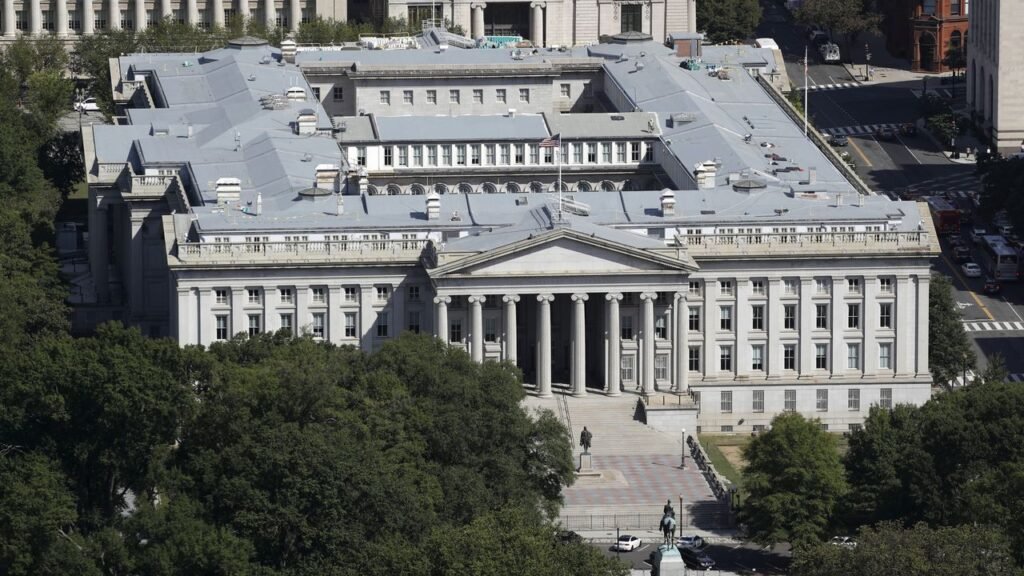
This Sept. 18, 2019 photo shows the U.S. Treasury Department building viewed from the Washington Monument in Washington. [AP Photo/Patrick Semansky]
The U.S. Treasury Department intervened this week to contain a selloff in long-term government debt, a sign of a mounting financial crisis that is driving an immense escalation of the class struggle. After the yield on the 30-year Treasury bond rose to 5.3 percent, its highest level since 2007, the department announced that it would at least double its purchases of long-dated bonds, to a minimum of $4 billion per operation, beginning September 9 and running through early November.
The move produced only a brief fall in yields before they resumed their rise. The failure points to the approaching limits of a financial order that has rested for decades on the unending expansion of US government debt.
Federal debt crossed $40 trillion this week, up from $5.7 trillion in 2000—and up from $38 trillion as recently as last October. Interest payments reached $963 billion during the first 10 months of the fiscal year, about $200 billion more than military spending and slightly more than Medicare. As yields rise, the government must pay more to refinance maturing debt. That increases the interest bill, requires still more borrowing and places still greater pressure on the bond market.
Successive Democratic and Republican administrations accumulated the debt through tax cuts for corporations and the wealthy, decades of unending war and repeated rescues of the banks and financial markets. After the crashes of 2008 and 2020, the government and Federal Reserve supplied trillions of dollars to protect the fortunes of the oligarchy and fuel another surge in stock prices, corporate debt and speculation.
The privileged global position of the dollar allowed the United States to carry this process far beyond the capacity of any other capitalist power. Central banks and financial institutions throughout the world accumulated dollars and Treasury securities as reserves, collateral and a store of value. This demand allowed Washington to finance deficits and military operations on an immense scale.
But the growth of the debt now corrodes the privilege that made it possible. The dollar has weakened, while gold has reached new heights, expressing growing doubts about the currency as a store of value.
The dollar index fell to a three-month low this week, and gold, which set a record above $5,500 an ounce in January, rose 4.7 percent on the week. “Expressions of debasement fears are a weaker USD and long gold,” Citigroup analysts wrote in a note reported Friday by Axios under the headline “‘Dollar debasement’ talk returns.”
“We do not doubt the ability of the U.S. Treasury to keep yields contained for quite some time,” the analysts added. “The main price to pay for lowering rates in such a way is a weaker currency.”

The historic decline of American capitalism is approaching a new stage. As David North explained in his opening report to the Ninth National Congress of the Socialist Equality Party, “the traditional remedies, fiscal expansion and monetary easing, are constrained by the mountain of debt and by the fragility of the dollar itself.”
Because the dollar and Treasury market occupy the center of world finance, the crisis assumes an inherently global character.
Wall Street has already announced who must pay. The Wall Street Journal identified Social Security, Medicare, Medicaid and other mandatory programs as the principal targets for further cuts. Referring to the attacks enacted last year, it declared in an editorial, “Republicans in last year’s tax bill made modest reforms to Medicaid, food stamps and student loans…. Alas, these changes don’t go far enough, and the GOP has shrunk from making bigger reforms.”
Those supposedly modest measures will take more than $1 trillion from Medicaid and the Children’s Health Insurance Program and $187 billion from food assistance over the next decade. Food stamp enrollment fell by more than 4.5 million people—11 percent, the steepest decline since 1997—between the signing of the One Big Beautiful Bill Act on July 4, 2025 and April, according to the Center on Budget and Policy Priorities. After enhanced health insurance subsidies expired on January 1, market place enrollment fell by more than a million, and the average monthly premium paid by enrollees rose from $113 to $178.
If these are “modest,” then it means that Wall Street regards them as only a down payment on wholesale attacks on Medicare, Medicaid and Social Security.
Axios quoted a note by Société Générale that summarized the choices confronting the US government in an article titled “Scott Bessent is the Strong Dollar’s Nemesis.” The note said, “Budget deficits remain high, this will be a growing issue, which will either force the U.S. to tighten fiscal policy, accept higher borrowing costs, or let the dollar weaken.” Translated from the language of the banks: austerity, rising interest rates or inflation—three different routes for imposing the costs of the crisis on the working class.
The wealth of America’s 977 billionaires rose by $2.2 trillion in the year to June, reaching $9.24 trillion, according to an analysis by Americans for Tax Fairness. But it goes without saying that any solution to the debt crisis which threatens the wealth of the oligarchy will not be considered.
The demands for austerity are determined not merely by subjective greed but by the deep crisis of American and world capitalism. The financial oligarchy can defend the immense mass of fictitious wealth only by continuously driving down the living standards of the working class at home and seizing foreign markets, resources and supply chains abroad.
More Stories
IMF report details a financial system with rising risks and vulnerabilities
Bowing to Washington’s pressure, Sri Lanka and India refuse to provide aid to Iranian ships
Marco Rubio declares West must dominate world, praises colonialism, erases history