By Carlos Lopes Pereira (guest author) posted on May 24, 2026
The author is a former member of the Secretariat of the African Party for the Independence of Guinea-Bissau and Cabo Verde (PAIGC). This article was published May 21, 2026, in Avante!, the newspaper of the Portuguese Communist Party. Translation: John Catalinotto
Thousands of Malians demonstrated on May 9 in Bamako, the capital city, and other locations, expressing support for the struggle that the government and the country’s armed forces are waging against “multiple terrorist and separatist groups backed by foreign powers.”
Two weeks earlier, on April 25, six cities in Mali, including the capital, were attacked by 12,000 terrorists and separatists in a coordinated operation. The fighting resulted in numerous casualties, both civilian and military, including Defense Minister Sadio Camara.
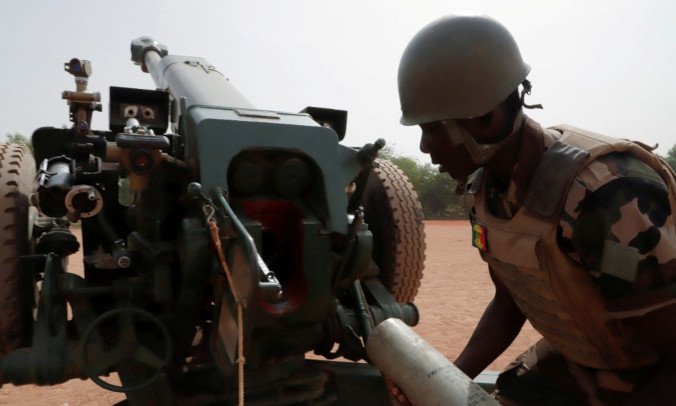
Mali, May 2026.
During the demonstrations on May 9 in Bamako, as reported at the time by People’s Dispatch, an independent international news outlet, thousands of people filled the Mamadou Konaté Stadium for a rally calling for “A Mali that stands firm, united, at peace and secure.”
Addressing the participants, Ibrahim Cissé, the president of the National Youth Council of Mali, called on young people to join the army in ever-increasing numbers to confront the groups promoting terror. “We refuse to be a generation of bystanders,” he emphasized.
Speaking on behalf of Malian women, Kouyaté Sissoko, a representative of the Coordinating Body of Women’s Associations and NGOs in Mali, stated that “we are all soldiers.”
Describing the April attack as “cowardly,” Issa Coulibaly, the government spokesperson and Minister of Territorial Administration and Decentralization, emphasized that “the Malian people have shown that they will not give in to fear or manipulation.”
‘Mopti will remain a bastion’
About 400 miles northeast of Bamako, the city of Mopti was also attacked by forces linked to al-Qaida and Tuareg separatists. Now, Malian civil society leaders have gathered there and heard the regional governor, Daouda Dembélé, assure them that “Mopti will remain strong and a bastion.”
Among the various demonstrations in support of Mali’s independence and sovereignty was, 265 miles east of Bamako, a large rally in the center of the city of San, in the region bordering Burkina Faso. Speaking to the participants — young people, leaders of women’s organizations and religious and traditional leaders — Félicité Diara, the president of the urban commune of San, paid tribute to the military personnel and civilians who fell in April and reaffirmed the region’s people’s support for the government led by Assimi Goïta.
Mali, along with Burkina Faso and Niger, is a member of the Alliance of Sahel States, and in recent years they have expelled French and American troops from their territories, banned foreign military bases and withdrawn from the Economic Community of West African States (ECOWAS), which has been accused of defending France’s neo-colonial interests.
Bamako, Ouagadougou [Burkina Faso] and Niamey [Niger] also accuse Paris — and more recently, Kiev [Ukraine] — of financing, training and arming terrorist and separatist groups in the Sahel (some of them even equipped with Ukrainian drones), seeking to prevent the peaceful development of countries that “dare” free themselves from neocolonial ties and choose their own future.
While acknowledging the complex current situation in Mali, President Assimi Goïta assures that “no violence, no intimidation, much less desperate attempts at destabilization” will reverse the progress the country has made. And he assures the Malian people that “sovereignty will be consolidated.”
More Stories
What makes Marxism scientific? – a scientific enquiry
The global rebellion of youth and workers and the war frenzy of the ruling class
Build the 20 November youth strike! Down with militarism! Down with capitalism!