The Democratic Republic of Congo is again in the grip of an Ebola outbreak, hundreds are dead already with millions more at risk as infections spread across central Africa. Yuri Prasad explores the ways in which imperialism and the search for profits paved the way for a new pandemic
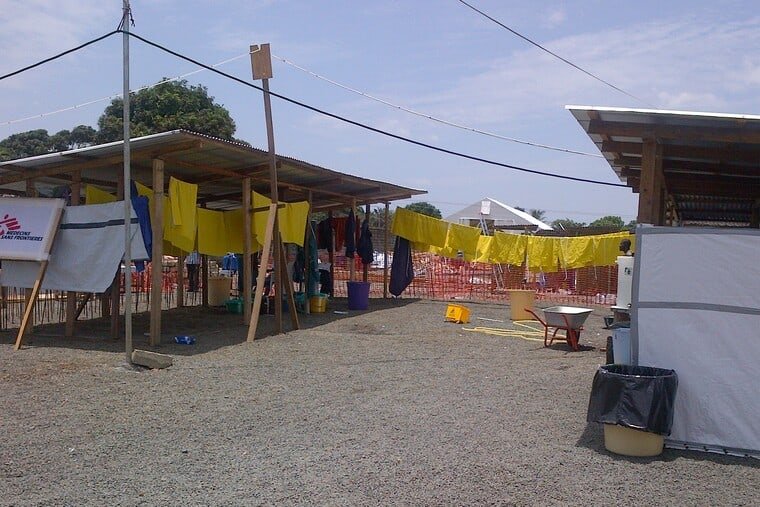
An Ebola treatment unit used in the 2014 outbreak (Photo: WikipediaCommons)
For the Democratic Republic of Congo (DRC), in the heart of central Africa, an abundance of vital minerals—including cobalt, coltan and gold—has been nothing but a curse.
The global scramble to control the country’s natural resources created some of the greatest horrors in the history of colonialism and imperialism.
From Belgium’s murder and mutilation of millions of workers forced to produce rubber in the late 19th and early 20th centuries, to the sponsoring of a civil war that still rages, Congo has been ravaged.
Today, another calamity is spreading in the country, and beyond to its neighbours. The DRC is the epicentre of a new outbreak of the deadly Ebola virus.
The World Health Organisation (WHO) said that by Friday of last week there were 139 suspected deaths and
600 cases. But the numbers are rising fast.
The actual number of dead may never be known because systems designed to alert public health bodies to an outbreak have all but collapsed.
Commentators discuss the infection in ways suggestive of a “natural disaster” for which no institution can be held responsible. Or they imply it is a product of Africa’s intrinsic “backwardness.”
Both of these notions are nonsense
Instead, it is the system based on exploitation of people and the planet that is really to blame. When corporations clear forests for mining and extract raw materials, for example, they increase the risk of contact between animals carrying disease and humans.
People are more likely to eat infected animals hunted in forest areas that were previously inaccessible. Or wildlife may move into human settlements it would have otherwise avoided because its own habitat has been destroyed.
These have been key routes for zoonotic transmission of animal diseases to humans—and are known to have caused earlier Ebola outbreaks in 2014‑16 and 2018-20.
It is no accident that the first cases in this Ebola outbreak were recorded in mining townships in the east of the country. Added to the long-term problem of mineral extraction and the destruction of the natural environment, is a new one driven by the hard right.
The US used to see it as a benefit for itself to fund robust disease surveillance networks across the region. It kept emergency teams of local health workers to take charge of public health crises.
But much of that ended when president Donald Trump shut down the US Agency for International Development (USAID) early last year. His “America First” policies declared that spending on aid was a “waste,” describing African countries as “shitholes.”
The Centres for Disease Control and Prevention also lost hundreds of experts, including some in the DRC, who would have helped contain the epidemic.
Last autumn, the Trump administration sacked hundreds of government scientists, including those working for the Epidemic Intelligence Service that specialised in combating Ebola.
These cuts have consequences.
The first known death in this outbreak was a nurse, on 27 April, which suggests that the virus has been spreading since early April. A delay in confirming the first likely cases of Ebola in the most recent outbreak happened because the samples were transferred to a laboratory at the wrong temperature.
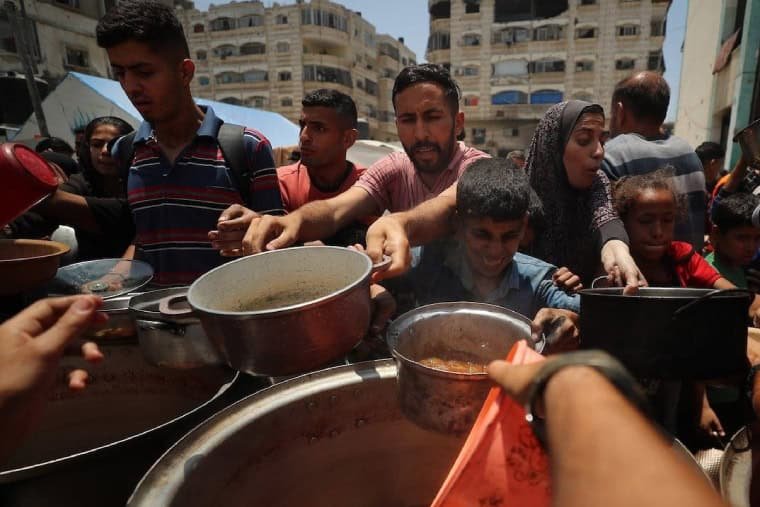
USAID would once have funded and managed that task. But no longer.
Congolese doctors are Ebola experts, but in previous outbreaks, they counted on US help with coordination and crucial supplies. Now that help has been reduced to a trickle.
The WHO budget has been cut by around 21 percent since January 2025, when Trump told the organisation the US was withdrawing from it. The US decision took effect this January and was then followed by Argentina.
Failure to quickly identify Ebola transmission allowed it to spread unchecked. Now there are cases in Goma, a Congolese city of more than a million people on the border with Rwanda.
Big power rivalry drives horrific war
There can be little doubt that the decades-long war in the DRC hampers all attempts to stop Ebola.
It is often presented as an “ethnic conflict” that defies rational explanation.
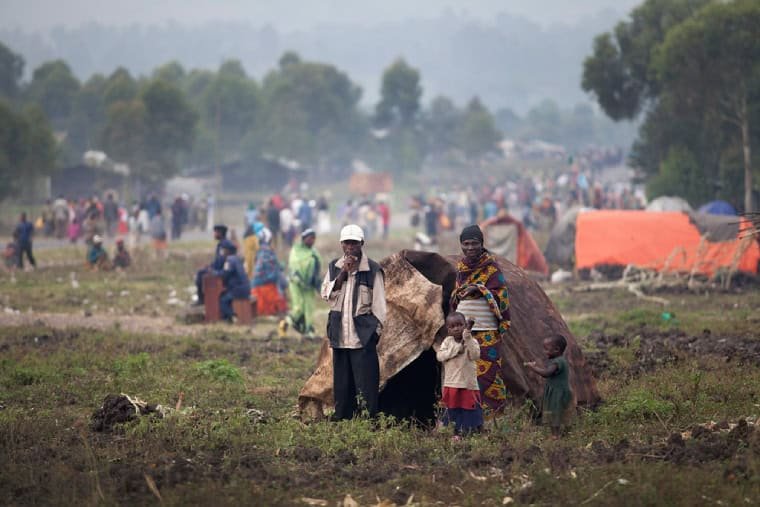
In reality, many of the world’s major powers are heavily invested in it. They have backed various governments, militias and the armies of neighbouring countries in the hope of grabbing “their share” of the DRC’s wealth.
The West is keen not only to take the region’s minerals for itself, but it also wants to prevent others, such as China and Russia, from snatching a share.
Russia has offered the DRC government political support and military hardware in exchange for natural resources. Meanwhile, China dominates the extraction, processing and export of most of the country’s cobalt.
The US and Britain have at times given both Rwanda and Uganda their backing, seeing them as “security partners.” That’s despite the United Nations gathering significant evidence that both countries have backed the M23 militias operating in the east of the DRC. And China has itself at times backed Rwanda.
The Congolese president recently offered Trump a deal—to assist his government in defeating these rebel militias in exchange for access to the minerals.
Western multinationals—including Apple, Google’s Alphabet, Microsoft, Dell and Tesla—depend on cobalt, much of it Congolese. Here, miners are as young as six years old and earn less than a dollar a day.
Extraction, rather than uplifting the DRC, is driving war and disease, and is making the working class poorer.
Overseas aid cuts – is this the end of ‘soft power’?
Trump’s cuts to overseas aid—and those of Britain’s—have undoubtedly worsened the Ebola crisis gripping central Africa.
The head of the campaigning charity Refugees International says US funding for the DRC dropped from over
$900 million in the last year of the Biden government to around
$179 million in the first year of Trump’s. That decrease has devastated an already weak health system, wrecked by war. But the US funding of USAID and the WHO, for example, was never simply philanthropy. All world powers use aid as a way of getting what they want, particularly in the Global South.
As opposed to the “hard power” of the military and war, aid was part of a plan for “soft power,” that could capture hearts and minds.
That’s why USAID food and medicine sacks transported to disaster zones are emblazoned with the slogan, “A gift of the people of the United States of America.”
Central Africa was a battleground for the main imperial powers during the Cold War of the 1950s and 60s, when the “Belgian Congo” was struggling for independence.
The US was determined that Russia should not win allies on the continent.
Instead, it wanted to influence Africa’s new rulers—and its offer of food, medicine, training and weaponry was designed to lure them in.
Those who resisted—including the first Congolese prime minister, Patrice Lumumba—were assassinated.
Aid came with strings that meant tying newly independent countries to the West through trade and credit, and politically tying an emerging African ruling class to the West. The purpose of aid was to create dependency.
In return for the West’s “generosity,” countries receiving aid were expected to be “hospitable” to imperialist military bases, spies and trade missions—and to act as outposts in times of regional conflict.
In time, it was also demanded that they open up their economies to the ravages of the free market and to repay international loans by slashing state spending. And if that led to revolt and rebellion that “soft power” could not deal with, there was of course “hard power” to fall back on. And that’s something that the Congolese people know to their cost.
More Stories
What makes Marxism scientific? – a scientific enquiry
The global rebellion of youth and workers and the war frenzy of the ruling class
Build the 20 November youth strike! Down with militarism! Down with capitalism!