Massive demonstrations of Indigenous Bolivians, workers and farmers have escalated into a nationwide siege demanding that President Roderigo Paz resign. Since May 9, they have built over 90 blockades surrounding the capital, La Paz, and isolating major cities.
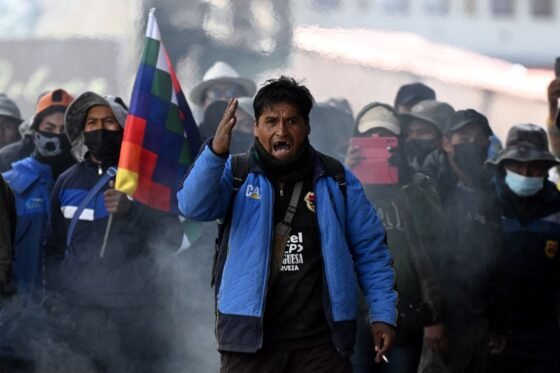
Thousands of demonstrators demanded the resignation of center-right President Paz in Bolivia’s political capital on May 22, 2026.
The blockades are choking off the distribution of food, fuel and other strategic materials, leaving thousands of vehicles stranded on highways. It is costing the current unpopular government more than $50 million per day.
Roderigo Paz is a U.S. client aligned with right-wing leaders of some of the Latin American countries, such as Javier Milei in Argentina. Paz is slandering the protesters as vandals out to destroy democracy. On June 7, Bolivia’s legislature passed a law granting the president the power to declare a state of emergency, giving the green light for him to deploy a military crackdown on protesters and clear the roadblocks.
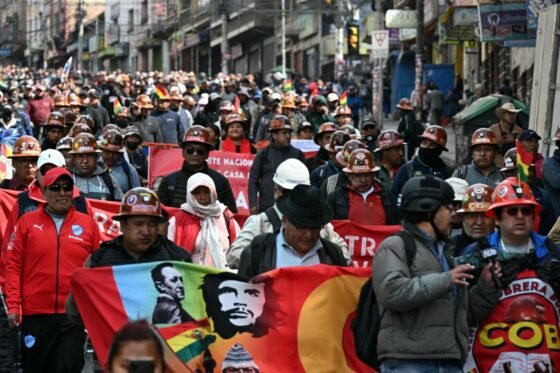
Miners, factory workers and Indigenous people march on the capital calling for the resignation of Bolivian President Rodrigo Paz in La Paz on May 22, 2026.
The speed and depth of grassroots self-organization surprised the Paz government. A large, united front quickly formed, with miners, urban and rural teachers, Indigenous communities, transport workers, peasants and labor unions under the Central Obrera Boliviana (COB). Protesters are demanding a stop to Paz privatizing their land and demanding he repeal his austerity policies that take food and fuel from workers and increase income for wealthy Bolivarians. Protesters have rejected negotiations with politicians and passive union bureaucrats. They are determined to continue the fight with strikes, vigils and blockades.
On April 8, some 3,000 Indigenous protesters, representing Amazonian and peasant communities, marched for 27 days over 600 miles from Northern Bolivia to the capital. They held a 10-day sit-in stating their demands.
Severo Marca, representative of the Unified Union Confederation of Peasant Workers of Bolivia, said the blockades will not stop, saying, “We are only representatives,” and “the grassroots are the ones who determine, and whatever they say we will comply.” He added: “We feel disappointed, we feel betrayed. This government must leave. There is no turning back.” (tinyurl.com/bdfex89y)
President Paz –– imperialist puppet
In the seven months since Paz took office, he has removed fuel and food subsidies that developed during Evo Morales’ 14 years as president. Paz increased diesel and gasoline prices that surged up to 163% and raised food prices by nearly 90%. His legislature passed the “Agrarian” reform Law 1720, which opened the door for agribusiness and foreign corporations to evict farmers and buy Indigenous land. He eliminated taxes on large fortunes of the wealthiest people. And he selected a cabinet without Indigenous members and with only two women.
At the same time that Rodrigo Paz called for dialogue with protesters, he kidnapped leading protesters including Justino Apaza, a leader of the Departmental Federation of Neighborhood Councils of La Paz and El Alto.
The U.S. government supports Paz and his austerity measures. Trump slanders the protests, calling them a “coup.” Paz flew to Miami in early March to meet with Washington and secure foreign investment. They are negotiating an IMF support program that could provide up to $3.3 billion in financing.
Rodrigo Paz was raised in the imperialist West. He grew up in Spain after his father was exiled for his role in Bolivia’s military dictatorships in the 1970s and early 1980s, and he graduated from American University in Washington D.C.
Evo Morales and Bolivian militancy
Bolivia, whose population is reported at about 12.5 million, with the largest proportion of people who identify with being Indigenous, is one of the poorest countries in South America. There are 36 distinct Indigenous cultures and nations. Years of colonization have never broken the strong, well-organized community bonds between the Indigenous communities.
Indigenous Bolivians have been successful in resisting colonialism since the Spanish invaded their Incan empire in 1532. They have a long history of militancy that includes highly successful blockade tactics, part of Bolivian culture since the late 18th century. They overturned pro-Western governments in 2003 and 2005 and paved the way for the election of Evo Morales.
Morales was the first Indigenous president. He led the formation of the political party Movement for Socialism (MAS). He was elected to three consecutive terms from 2006 to 2019. In 2006, the government under the leadership of MAS passed a law authorizing redistribution of land among the nation’s mostly Indigenous poor. In 2009, they implemented the Plurinational State of Bolivia, a multiethnic society recognizing all Indigenous nations. All Bolivians became citizens of the state and their distinct Native heritages became recognized.
Morales’ government nationalized several oil and gas industries and increased taxes and royalties on multinational firms and foreign companies, diminishing their strategic control and decision-making power. Those companies were reduced to contractors that carried out specific tasks. They lost their influence, profits and intellectual property, and their rights to core technology, brand or product.
Profits from state-owned industries were made during a period of high global fuel prices. They were used to fund the development of Bolivian infrastructure and entitlement programs. Poverty and income inequality were greatly reduced.
After nearly 20 years of socialist measures, poverty rates fell from 60% to less than 20% and extreme poverty fell 70%. Previously, the richest 10% of Bolivians held 128 times more wealth than the poorest 10%. During the period of those measures, this ratio became 37 to 1, reducing inequality.
International support
The Morales government developed a strategic trade relationship with China and became a partner in China’s Belt and Road Initiative. China supplied Morales with vital economic, military, and diplomatic support and most of Bolivia’s electric vehicles. Chinese companies helped Bolivians develop their infrastructure, energy and mining.
China pledged billions in loans for projects including highway construction and agricultural development. They funded and built Bolivia’s first telecommunications satellite, the $251 million Túpac Katari, launched in 2013. China’s non-interference approach to Bolivia’s internal politics helped Bolivia maintain independence from the U.S. and Western imperialism.
Bolivia has some of the world’s largest lithium reserves. Chinese firms have committed over $2.3 billion to help develop Direct Lithium Extraction (DLE) in hours or days, rather than months or years.
Since Paz was elected president, the number of Chinese companies operating in Bolivia has fallen from over 60 to fewer than 20 today. Major infrastructure contracts and resource extraction for Chinese firms have ground to a halt.
Colombian President Gustavo Petro defended the recent Bolivian demonstrations, calling them a struggle for Latin American dignity. In response, the Bolivian regime kicked out Colombia’s ambassador, Elizabeth García, on May 20, and accused Petro of interfering in Bolivia’s domestic affairs.
The Wiphala Network is an international organization advocating for Indigenous rights of Andean peoples. On June 9, this network issued an International Complaint to the Inter-American Commission on Human Rights (IACHR), part of the Organization of American States (OAS).
This complaint read: “Rodrigo Paz’s total loss of governance and credibility is evident to the majority of Bolivians, and the only way to bring peace to the country is through his resignation! We call for international solidarity to ensure that human rights are respected in Bolivia.” (pressenza.com, June 10)
More Stories
IMF report details a financial system with rising risks and vulnerabilities
Bowing to Washington’s pressure, Sri Lanka and India refuse to provide aid to Iranian ships
Marco Rubio declares West must dominate world, praises colonialism, erases history