Enrique Rodriguez Pamanes, 29 May 2026

The cities of La Paz and El Alto have for weeks been inundated with marches, pitched battles with police, strikes, and blockades, sparked by the fight against counterforms and inflation. Now, the struggle has gone beyond these demands, and is calling for the right-wing government fall. How did we get here, and where is the movement going?
Over 120 have been hurt and at least seven killed by police repression since the movement started on May Day. One man, shouting in the street captured the popular mood, saying:
“Comrades! We have said enough is enough! … We don’t want any more exploiters! In Bolivia we don’t need exploiters. In Bolivia, there shouldn’t be exploiters or exploited. What we want is progress for everyone. And I want to say to the people of Bolivia, if we’re going to advance, we need to go until the end.”
This movement is an inspiring sight to millions internationally. Reports of workers and peasants occupying entire city blocks are being followed closely, and are raising the question of who really runs society. Last Saturday, the convoy of public works minister Mauricio Zamora was ambushed on its way to oversee the breaking of blockades. Workers and peasants pelted it with stones and sticks of dynamite. Zamora fled down a dirt road, only to be ambushed again before fleeing. The state is now mobilising bulldozers and the military to clear blockades which have choked millions of dollars in trade.
But videos and pictures do not tell the whole story. This is a struggle that’s been developing for years.
Paz el Incapaz
Bolivian President Rodrigo Paz won the Bolivian elections last November. His honeymoon was almost nonexistent. As we wrote at the time of his election:
“Comrades! We have said enough is enough! … We don’t want any more exploiters! In Bolivia we don’t need exploiters. In Bolivia, there shouldn’t be exploiters or exploited. What we want is progress for everyone. And I want to say to the people of Bolivia, if we’re going to advance, we need to go until the end.”
These attacks came quickly. In December the state eliminated fuel subsidies, with the price of gasoline rising by 84 percent and that of diesel by more than 100 percent (from 3.72 to 9.80 Bs. per litre).
On top of this, the gasoline and diesel now being brought in is of poor quality and has ruined thousands of cars. Workers are paying more, and getting garbage. Paz promised to fix the economy, but has made matters worse at a rapid pace
His government did not come to power because people want austerity, but because the traditional party of the workers and peasants, the Movimiento al Socialismo (MAS), has been fractured.
In power for nearly 20 years, MAS used to win elections by massive margins. Their programmes of reforms drastically reduced poverty and increased the standard of living. But their programme never broke with capitalism, and was based on increasing royalty incomes from gas and mining. When the price of these commodities dropped in the 2010s, so did the state’s budget, and they dutifully attacked workers, going as far as opposing demands for higher minimum wages and calling striking workers “pawns of the right wing.”
As a result, MAS lost popularity, setting the stage for the 2025 election disaster.
Divisions between MAS leaders Evo Morales and Luis Arce further divided the party. This leaves a gaping political vacuum on the left in Bolivia, just as the world crisis of capitalism is smashing the Bolivian economy to pieces.
The second round of the presidential election was a straight choice between Paz and Tuto Quiroga, an open representative of the reactionary Bolivian oligarchy. Many voted for Paz just to keep Quiroga out, as Paz consciously presented himself as the more moderate, centrist figure.
The spark of the current movement
The current struggle was catalysed by the promulgation of decree 1720, which aimed to privatise small landholdings and incorporate them into larger ones. This is difficult to do in a country like Bolivia, where there are strong revolutionary traditions of defending land against such attacks. Instead, by removing restrictions for land to be used as collateral for loans, they hoped to take these lands piecemeal as ruined peasants inevitably default.
Bolivia has one of the most unequal land distributions in the world. There are currently 500,000-600,000 smallholder farmers making up 84 percent of farms in Bolivia, but which take up less than three percent of the land. These small landholders produce the majority of the food consumed internally. This is because large landowners – who make up 1.2 percent of farms – own 80 percent of the land and use it for cash crops like soy and sugarcane. If implemented, decree 1720 would therefore destroy Bolivia’s food sovereignty.
The main trade union federation, the Central Obrera Boliviana (COB) had come under immense pressure after their lacklustre settlement during the campaign against fuel hikes in December. COB leader Mario Argollo decided to hastily sign an agreement with the government to repeal the fuel hike, at a time when mobilisations were on the rise and he was in a strong position to demand much more. For this, he was heavily criticised, and in the months that followed, he faced backlash from within the COB.
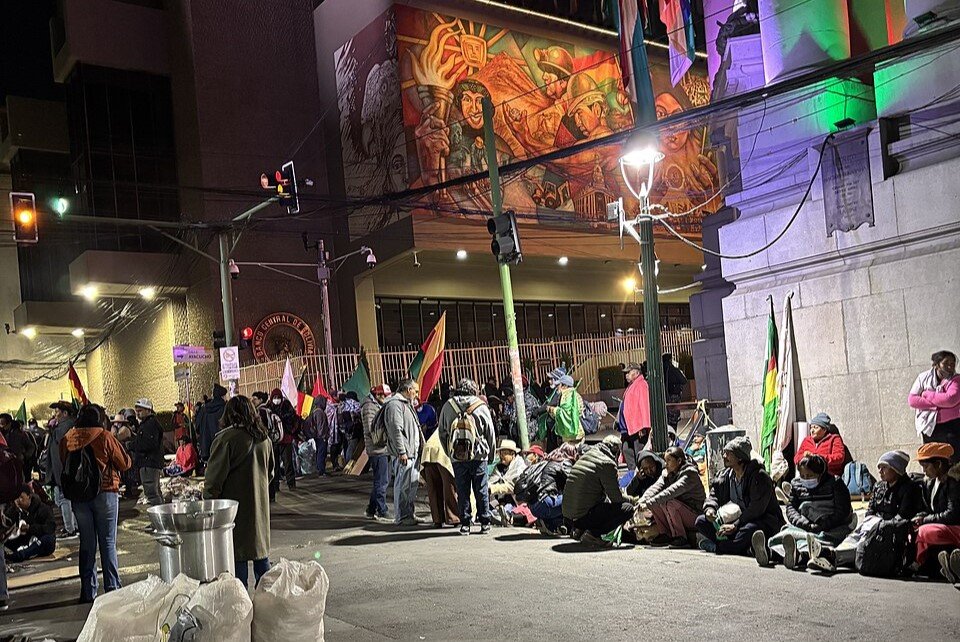
Bolivia has one of the most unequal land distributions in the world / Image: Wawitasny7, Wikimedia Commons
The rise of fuel costs from the war in Iran made inflation surge to 20 percent at the start of the year. The COB, under relentless pressure, called for an ampliado nacional, or a large scale assembly on May Day in La Paz against decree 1720. This coincided with a 1,100 kilometre march of thousands of indigenous peasants from the Amazonian territories of Beni and Pando, set to arrive in La Paz on the same day. Both bodies demanded wage increases to fight inflation, alongside peasant groups which called for a repeal of decree 1720. The COB then called an indefinite general strike, and representatives of ten of the country’s largest organisations signed an ‘Agreement of Unity and Loyalty’ with the goal of bringing down the Paz government.
This time, the masses were not willing to accept the kind of settlement made during the campaign against fuel hikes, and their radicalism and militancy very quickly swept the COB leaders aside. When Argollo called for an indefinite general strike on 1 May, he probably thought it would be just another mobilisation, one of the many that take place in the country. He miscalculated, a fact he himself had to admit last week, saying that “the rank and file have overwhelmed the leadership.”
The problem is that there is no one to replace these leaders by offering a clear alternative. There is no unifying programme, and the level of organisation among the masses is very limited, and almost entirely spontaneous in nature, given the current leaders’ inability to take any real initiative.
Every day there are more cases of leaders signing agreements with the government behind their rank and file’s backs, only to be later repudiated and rejected by the masses, who are no longer willing to be led by the nose. The COR in El Alto, the FEJUVEs, and the CSUTCB are just a few examples of trade unions where self-serving and self-appointed leaders have recently signed agreements behind their rank and file’s backs, thinking they could continue behaving with impunity as they had in the previous period.
In Bolivia there exists a tradition of using mass marches and blockades as a bargaining chip to wring out concessions, with the leaders using very radical sounding rhetoric, but without the further perspective of taking political power. They treat the movement like a tap that can be turned on and off at will.
The state has issued arrest warrants against the leaders of the COB, who have been forced underground. This will only add fuel to the fire and not solve any of the contradictions being expressed on the streets.
Class divisions in the movement
One of the main weaknesses of the current wave of struggle is that the COB leaders launched a general strike without having carried out the necessary political and organisational preparations for it. Thus, the movement has become centred around the capital, with no actual strikes or mobilisations in the main cities and proletarian centres outside of it. Several of the departmental COB unions (CODs) have not joined in the movement and have not even called for solidarity demonstrations.
Reports from the ground show confusion in places outside of La Paz and El Alto, where the movement’s turnout has been minimal and May Day rallies did not even occur. Many of the COB leaders went to La Paz and neglected to organise in their home districts, with May Day demonstrations in cities like Cochabamba remaining deserted.
This lack of a coherent slogan, programme and, in short, leadership, allowed the vacuum to be filled by outside elements.
Most foreigners following on social media likely saw miners marching in the streets. What they don’t know is that these are mostly cooperativistas from the Federación Departamental de Cooperativas Mineras (Fedecomin).
The cooperativistas number around 100,000-120,000 nationally. They are precarious workers contracted by the day who don’t have the same rights or benefits as COB miners. The Fedecomin is not a union, but a bosses federation. This bloc acts politically in the interests of small to large proprietors, many of whom have made fortunes on gold mining. The Fedecomin are often at odds with the COB and the working class in general. Their demands were for higher fuel subsidies, deregulation of mining, and further privatisation of the mining sector.
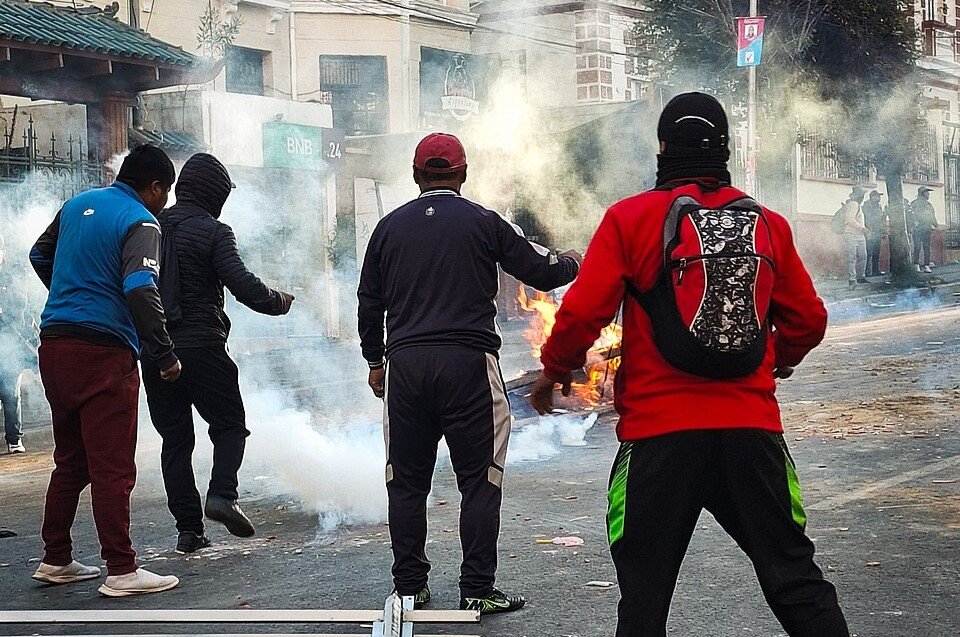
For now, the strike and the movement is completely out of the hands of the COB / Image: N1ny4 t, Wikimedia Commons
The miners of the COB, who are seen as the vanguard of the working class and have been at the forefront of the most titanic struggles, were not out in numbers at the start of the movement. The COB organises 10,000-15,000 salaried miners at the state owned company, COMIBOL and are organised in the powerful Miner’s Federation FSTMB.
The COB demands nationalisation and for more regulation to defend their health and the environment. The Fedecomin has come out against minimum wage increases, as it means they’d have to pay their workers more, though most of their workers aren’t even under the protection of labour laws, have no benefits, and get paid less than minimum wage.
The leaders of the cooperativistas struck a deal with the state two weeks ago, which gave them further permission to mine in protected areas and forgave their millions of bolivianos in debt to the national health authority, the Caja Nacional de Salud (CNS). This has caused the CNS to declare a state of emergency as money which was set to come in suddenly evaporated.
Most incredibly, when the president of Fedecomin-Potosí, Óscar Chavarría, was asked if his miners would help clear COB and indigenous blockades, he said: “We could. As you know, Fedecomin-Potosi is big and we could use our power in that way.”
When he was asked about the slogan “Out with Rodrigo Paz” he added:
“We are not in agreement with that, and neither are other cooperatives that are demonstrating. For us it’s not political… as you know, COB and other institutions have used our legitimate gripes to fight for political power, but not us. And as we’ve said, we’re not going to permit the old government to return to this country.”
The miners marching under the Fedecomin banners are honest elements, and are being exploited by the same people making backroom deals with the president. The COB should be taking this golden opportunity to break them off from their leaders and organise them within the COB, rather than leaving them at the mercy of the bosses
For now, the strike and the movement is completely out of the hands of the COB. The Fedecomin and other sectors have struck deals, but at the time of writing, demonstrations continue in the capital, and the blockades still stand, demanding the fall of the government.
Déjà vu
Bolivia has a proud revolutionary tradition. The twentieth century started with a wave of working class, peasant, and indigenous insurrectionary movements, beginning with the ‘Water War’ in Cochabamba in 1999-2000.
In that victorious struggle, the workers and peasants defied the attempts at water privatisation through a series of uprisings.
Then came the two ‘gas wars’ in February and October 2003 and in May-June 2005. These were insurrectionary movements sparked by the demand for the nationalisation of gas. The mass of workers and peasants paralysed the country with road blockades and a powerful general strike. The government buildings were surrounded by miners armed with dynamite. The president was forced to resign.
The COB could have taken power, and even talked about it in their own statements. They failed, however, to take the situation to its logical conclusion.
This mass radicalisation eventually led to the MAS electoral victory. They took political power, but without breaking with capitalism. Twenty years later we are back to a similar situation of high inflation and a falling standard of living. The lesson from the past is clear: either the movement of the workers and peasants will take power, or it will be repressed into submission and the opportunity will be lost.
The current state of blockades and mobilisations cannot last forever. The state has used concessions, even ones it can’t pay for, to buy off sectors of the movement. They are using the carrot, but also using the stick at the same time.
Paz recently warned the country is ‘at breaking point’ after a month of protests, and the Congress recently voted to make it easier for the president to declare a state of emergency and use the military to regain control. But the government remains weak, not wanting to risk pushing the movement forward with all-out reaction. It is advancing timidly, though on the streets of La Paz and El Alto they continue to beat workers and shoot tear gas.
We can be sure workers in Argentina, Chile, Ecuador, Peru, etc. are watching this movement closely, as they face the same problems of inflation and economic collapse. The movement may have started in non-ideal conditions, but they cannot stop halfway now. The COB must broaden the struggle.
To consolidate and unify the protests, it is essential to develop a single platform of demands: what are we fighting for? The demands of the different sectors must be united into a single struggle, demanding: wage increases and automatic indexation of prices and wages; an end to repression, the withdrawal of arrest warrants, and punishment for those responsible; the reversal of the gas price hike, and measures to make the rich pay for the crisis.
Bolivia is a rich country: in minerals, biodiversity, and agriculture. Its fertile lands could feed entire countries in South America. But the capitalists and imperialists are turning the country into hell on earth. In the last instance, the question today is the same as in the 2000s: will the workers take power, or will the reaction win? Ultimately there is no other path forward.
More Stories
What makes Marxism scientific? – a scientific enquiry
The global rebellion of youth and workers and the war frenzy of the ruling class
Build the 20 November youth strike! Down with militarism! Down with capitalism!