The ruling class has no solutions to environmental problems, workers will need to organise, writes Rebecca Givan
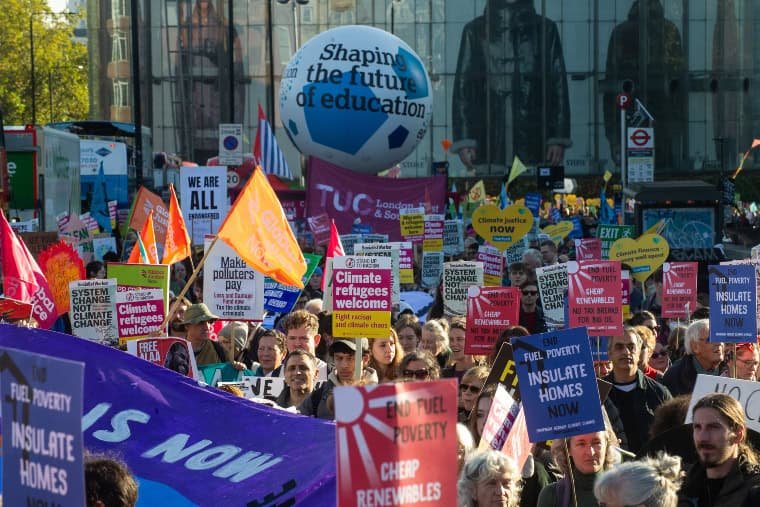
There is a social force that has the power to resist climate change—the organised working class (Picture: Guy Smallman)
Large areas of England and Wales are facing drought conditions. And the death toll from heatwaves this year has reached nearly 3,000 in Britain alone.
The climate crisis is impossible to ignore.
Yesterday’s climate deniers have become today’s climate pessimists who say nothing can be done about climate breakdown other than trying to mitigate the impact.
The climate justice movement has rightly argued that it is working class people and the poor who will be on the frontline of the climate crisis.
But the ruling class cannot entirely escape its impact either.
They have their swimming pools, their air conditioning and their space and privacy. But their luxury holiday homes in the south of France and Greece are also burning.
And they have no solutions.
The climate catastrophe cannot be solved within the capitalist system—the logic of competition won’t allow it.
Some individual capitalists might develop greener business plans or invest in carbon offsetting.
But they can’t allow these policies to eat into profits or they risk their businesses losing out to their rivals.
The bosses are locked into the logic of competition. They have to compete to reduce costs and maximise profits, to introduce new technology whatever the cost to the planet.
When the bosses come under pressure, green investments are often the first to go.
For example, the shipping industry has recently abandoned its climate commitments because the war on Iran has eaten into their profits.
But the logic of the capitalist system means there is a social force that has the power to resist climate change—the organised working class.
Heatwaves can intensify simmering discontent in the workplaces.
Bus drivers in north London have struck this summer over the sweltering temperatures in their cabs.
Last month, workers employed by the V&A museum voted to strike over the lack of toilet and drink breaks after a worker fainted.
Over the past few years, workers at the Parthenon in Athens, bus drivers and McDonald’s workers in Italy and Amazon drivers in the US have taken action against their inhumanely hot working conditions.
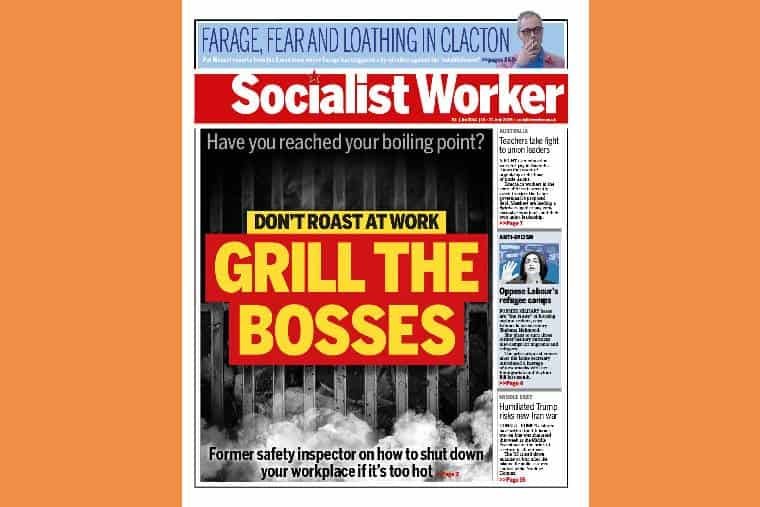
Workers can act to defend themselves against some of the effects of climate change. And, there is a history of workers taking action over the environment, preventing developments that would make the crisis worse.
In Australia in 1971, workers in the New South Wales Builders Labourers’ Federation joined a fight against a block of luxury flats that was to be built on a section of bushland, Kelly’s Bush.
Union members boycotted work on the development. They said, “If one blade of grass or one tree is touched this half-completed building will remain forever half-completed as a monument to Kelly’s Bush.”
The struggle spread across Australia, becoming known as the Green Ban movement.
Between 1971 and 1974, workers boycotted 42 similar developments, worth 46 billion Australian dollars.
The builders became the first union in Australia to appoint Aboriginal people as organisers. They joined in with struggles against racism and for LGBT+ rights.
Struggles against climate change can mobilise workers and fuel wider resistance. In Iraq, in one of the world’s hottest regions, climate change interacted with the legacy of imperialism to poison water supplies—and sparked mass resistance.
In 2018, higher temperatures led to the Tigris and Euphrates rivers reaching historic lows. Seawater washed upstream, increasing the saltiness of the drinking water supply.
This combined with pollution from industrial waste and the US bombing campaign of 2003 which destroyed water sanitation centres.
The water was poisoned, killing people and livestock alike.
Some 100,000 Iraqis were hospitalised after drinking the poisoned water.
This crisis exposed the corruption and the priorities of the Iraqi state. It provoked mass resistance in the city of Basra in August 2018 where workers demanded clean drinking water.
This determination hasn’t gone away.
Last May, residents of Basra occupied the local government offices demanding an end to pollution from nearby oil operations. They also demanded the construction of a promised desalination plant.
The protesters were forced out, but they warned that they would continue to campaign until their demands were met.
In Tunisia, climate demands have been feeding into resistance to dictatorship.
On 1 August this year, thousands took to the streets in Tunisia’s capital, Tunis, to protest against power cuts implemented by the state-owned energy company to offset the rising demand for air conditioning.
Tunisians blame the government’s poor planning and some are calling for “another revolution”.
Protesters are openly organising against the regime—which has suppressed dissent and cracked down on what it calls “fake news”—and some are calling for the president Kais Saied to resign.
And last October, a general strike and tens of thousands of protesters brought the southern Tunisian city of Gabes to a standstill as anger intensified over a pollution crisis caused by a state-run chemical plant.
Shops, markets, schools and cafes shut down, halting economic activity in Gabes in response to a call by the powerful Tunisian General Labour Union.
Protesters marched through the city chanting slogans such as “dismantle the polluting units” and “Gabes wants to live”.
Residents say the plant, opened in 1972 to produce fertilisers, is responsible for a surge in gas poisoning, cancer cases and collapsing marine life.
The plant releases radioactive waste into the air.
The Tunisian workers have the potential to end this pollution and protect the environment.
The climate catastrophe poses sharp questions for British workers.
The North Sea oil industry is declining and jobs are fast drying up. BP has already announced hundreds of redundancies, and hundreds more are at risk as it sells off its North Sea oil business.
If we want to stop climate change we can’t support this dying industry that contributes massively to carbon emissions.
But workers can’t be left behind. They need a just transition away from oil and gas that includes retraining and new jobs. Workers themselves must be central to shaping that process.
In the 1970s, Lucas Aerospace—one of the largest employers in Birmingham at the time—announced plans for thousands of redundancies. In 1976, shop stewards drafted the Lucas Plan.
The Lucas Plan was a radical call for workers’ control.
It argued for the workers to be allowed to use their skills to develop solar battery cells, wind turbines, hybrid cars and heat pumps without any
redundancies—it was a call for a just transition.
The workers wanted to use their skill for the social good, and not for profit. The Lucas Plan can inspire workers today.
The North Sea oil and gas industry is a lot less unionised than Lucas Aerospace was, and union leaders in the industry are more timid than in other industries.
They prefer to work through existing frameworks instead of directly challenging the bosses.
But North Sea workers can still take action.
The tight environment of the oil rig means that every worker matters.
In 2022, wildcat strikes began to spread demanding a “wage revolution”, resisting the bosses and defying the union leaders who told them to go back to work. Workers on some rigs discussed escalating by stopping helicopters from landing.
As a result of the strikes, workers got a “vastly improved” pay offer. They also got a taste of their own power.
Oil and gas workers need to use that power again to demand that, as their employers pull out of the North Sea, their skills are used in ways that help the planet instead of destroying it.
Workers can demand adaptations to cope with the climate crisis and the heatwaves—air conditioning, water breaks and a maximum working temperature.
Reformist leaders have no strategy capable of stopping climate change. They talk about long-term, gradual change, but urgent action is needed now. Andy Burnham must say no to new oil and gas drilling, and must invest in green energy.
Struggles against pollution, heatwaves and AI data centres have the potential to spark a movement against climate breakdown led by the organised working class.
Across the world, it’s workers who suffer the most from climate change, and it’s workers who have the power to lead the fightback.
More Stories
IMF report details a financial system with rising risks and vulnerabilities
Bowing to Washington’s pressure, Sri Lanka and India refuse to provide aid to Iranian ships
Marco Rubio declares West must dominate world, praises colonialism, erases history