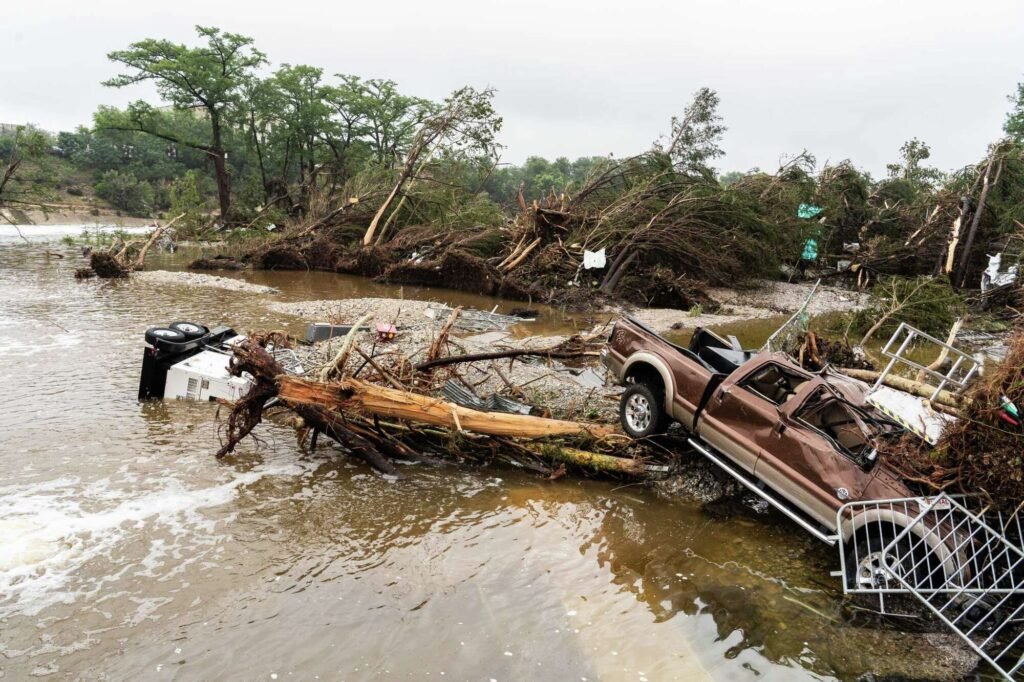
The flood at Camp Mystic in the Texas Hill Country in the summer of 2025 was an example of how not to handle rescue and recovery from natural disaster.
Capitalist and socialist societies are often compared using varied criteria, from economic to political. Perhaps one of the most telling and most important measures by which a society can be judged is how it responds in times of crisis. In what order are people prioritized for rescue and relief and on what basis?
When comparing the examples of the United States, China and Cuba, the distinction between the systems present in each country comes to light. There are common factors too, regarding China and Cuba, who share a socialist societal framework.
Neglect and devastation in the U.S.
Several weeks ago, a wave of floods struck the Texas Hill Country, devastating homes and other property in addition to killing two local residents, John Mark Steward of Kerr County and an as-of-yet unidentified 74-year-old man from Uvalde County. Gov. Greg Abbott bragged in a Facebook post that the state government’s response was a “show of force.” The reality of the situation, however, paints a picture not of decisive rescue but of passivity and inaction.
During the initial flooding, Texas authorities signed a major disaster declaration, pleading with the federal government in a largely fruitless bid for aid. Meanwhile, private charities and organizations mobilized to provide relief. Only one of these organizations has any connection to the state.
We are watching in real time as working-class Texans move to rebuild their own communities with their own labor and wealth, all while the oligarchic government bargains for crumbs from the table of wealth stolen from what U.S. workers produce in the capitalist economy.
Cuba and socialism under siege
Cuba has been hit by every tool in the arsenal of imperialism since the ousting of the U.S. puppet, President Fulgencio Batista, on Jan. 1, 1959. From sanctions to blockades to literal assassination and kidnapping attempts against Fidel Castro, the U.S. has relentlessly pursued the end of socialism in Cuba for over 60 years.
And yet Cuba’s emergency response system is one of the most highly developed and effective programs for such a purpose in the entire region. During the period of 1996 to 2002, while Cuba was still dealing with economic fallout from the dissolution of the Soviet Union and the loss of its most important economic partners, the five hurricanes combined that made landfall on Cuba took the lives of only 16 people.
When Hurricane Ivan struck two years later in 2004, it claimed zero victims. This shows a massive capability within Cuba’s socialist system to rapidly improve their response to events which directly impact the safety of their citizens.
China leverages development for the purpose of the people
Although there are private companies in China subject to market forces, the overall economy is controlled by the ruling Communist Party, which restrains the drive for profits. The wealth produced by this economic system is used for development and the needs of the people. This has led to rapid, effective responses in areas like Guangdong, hit hard by natural disasters.
Most recently, the Chinese government dealt with Typhoon Noul, which intensified before hitting Guangdong, causing damage which forced the evacuation of over 700,000 people. The government immediately allocated 100 million yuan (about $15 million) for recovery efforts. In addition, private companies have been ordered to suspend operations and stay out of the way while the government organizes the recovery.
For workers, the contrast is clear
Working-class citizens of Kerr and Uvalde County would be astounded by the idea that their government had issued millions of dollars for their recovery so quickly. Such a thing is largely unheard of to most people facing a disaster in capitalist countries. The message is clear: When private, capitalist institutions are relied upon to solve problems, the profit motive inevitably leads to delays in recovery efforts, which should be far more rapid.
The citizens of Flint, Michigan, who were subject to over a decade of undrinkable water, are intimately familiar with the fact that the system can take years to work on its own. Even then it needs to be pushed and prodded at every turn. The system didn’t work for them, and it hasn’t worked for Texas, either. Subject to these disasters, the majority of working-class people can more easily realize that the system fundamentally doesn’t work for them.
More Stories
IMF report details a financial system with rising risks and vulnerabilities
Bowing to Washington’s pressure, Sri Lanka and India refuse to provide aid to Iranian ships
Marco Rubio declares West must dominate world, praises colonialism, erases history