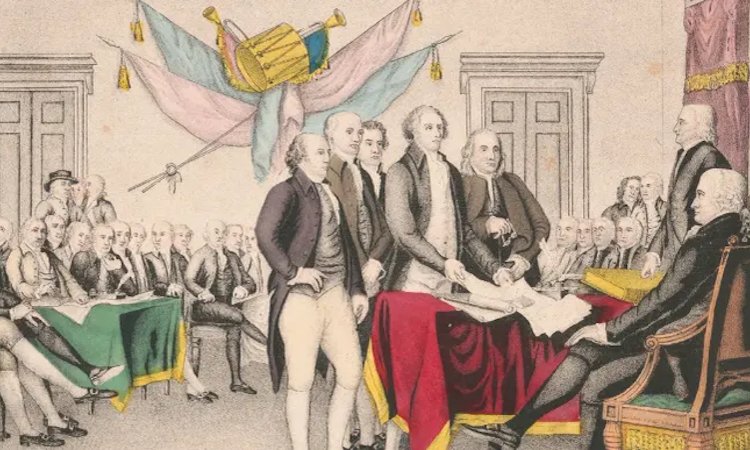
This 4 July 2026 marked the 250th anniversary of the signing of the American declaration of independence. Celebrations of the 250th anniversary of the country’s founding took place across the USA and even across some of the USA’s more subservient neo-colonies. Flashing billboards celebrating the event could be seen in Lebanon and south Korea
While it continues to be brandished and lauded by the US ruling class as signalling the birth of true freedom and democracy for all the civilised world, the declaration’s noble-sounding words have long-since had a hollow ring in the ears of the oppressed peoples of the world. As of course they did from the first to the enslaved, the genocided and the propertyless members of the US population.
Who hasn’t heard such phrases as “all men were created equal”, “inalienable rights” and “life, liberty and the pursuit of happiness” trotted out when they were deemed useful to some nefarious purpose of US imperialism – only to be quietly dropped (or redefined) when they became inconvenient?
The settlers’ anti-colonial revolution
British colonial rule was well established in the then 13 colonies of north America under a system of mercantilism whereby the colonies existed solely to enrich the ‘motherland’ through the looting of their rich resources, and to provide a market for Britain’s expanding industries.
The British rulers enforced a strict monopoly over their colonial markets, and compelled adherence by local businesses to laws and trading rules that maintained the status quo and limited the scope for development of the US bourgeois class.
As a result, the lion’s share of the profits to be made from the looting of North America’s tremendous natural wealth was funnelled into the coffers of merchants, landowners, bankers and shareholders in Britain – a revenue stream held firmly in place via the institutions and legal framework enforced by ‘the Crown’ (ie, by British administrative and military rule).
As the American colonial population grew, antagonisms began to develop between the burgeoning homegrown bourgeoisie and its dominant counterpart in Britain. As time went by and its members accumulated more wealth, they came more and more into conflict with the strict regime of British colonial control.
US bourgeois expansion was further restricted by the British ban on colonists trading with other nations, which kept the prices of American exports low, kept the scope of its manufactures narrow, and raised the prices of the many imported goods on which the colonial population relied.
Expansion by American colonists westward across the continent was also restricted by British interests, which blocked settlement expansion. The taxation system was used to further exploit the colonies, and, much as had the English Parliamentarians under the rule of Charles I or the French revolutionaries under the regime of Louis XVI, the US bourgeoisie grew increasingly frustrated at having no say in how taxes were levied or used.
The Stamp Act of 1765 put in place a requirement that no printing should be carried on ‘unstamped’ (ie, untaxed) paper – a rule that covered everything from legal documents, magazines and newspapers to playing cards. The Townshend Act 1767 (named after the then chancellor of the exchequer) levied fresh taxes on many key imports including leaded glass (increasingly sought after for townhouse and commercial building), paper and tea.
Developing tensions between London and the colonies resulted in a growing movement against colonial despotism, under the famous slogan: “No taxation without representation.” As class conflicts continued to grow, so did the movement for total independence from Britain, which in turn led to the revolutionary war and ultimately to the foundation of the United States of America in 1776.
The Founding Fathers who led the revolutionary war and signed the declaration of independence include well-known figures such as George Washington, Thomas Jefferson and Benjamin Franklin. While many of the revolutionaries, both in the leadership and amongst the wider population, were inspired by revolutionary movements and writers from Britain and France, all those who penned the declaration belonged to the wealthy elite of American landowners, merchants and slave plantation owners.
Thus, as was the case in the English and French revolutions before them, while their cause was a progressive one insofar as it sought liberation from British colonial rule, it did so in the interests not (as it claimed) of ‘all men’ but of the property-owners. Likewise, it fought not for universal ‘freedoms’ and ‘equality’, but for the freedom and equality of bourgeois men.
The enslaved population accounted for one-fifth of the population at the time of the revolution. Indeed, most of the freedom-loving Founding Fathers were slaveowners. The ‘inalienable rights’ trumpeted in the declaration thus did not apply to the slave population, to native Americans, to women, or to the propertyless working masses.
The replacement of one set of exploiters by another has, of course, been the aim of every revolutionary movement up until the time of the Paris Commune and the October Revolution, which for the first time brought into view the prospect that humanity might finally achieve liberty, democracy and genuinely equal access to all the things that make life fulfilling and worthwhile.
Nevertheless, by moving the wheel of history forward, by breaking the fetters of feudal or colonial regimes, the bourgeois revolutions that ushered in our present capitalist era were both necessary and progressive, opening the road for the vast development of humanity’s productive forces, which in turn is the necessary precondition for our further advance to socialism and communism.
What is not true is that these revolutions were the ultimate end-point of our history, or that they established genuine freedoms for all, as their myth-makers would have us believe. Under the banner of ‘equality for all’, a new ruling class replaced the colonial regime, leaving workers, enslaved and indigenous peoples subject to intense exploitation and ever-growing inequality.
Votes for white women were only won across the whole territory of the USA in 1920, while truly universal suffrage only arrived after the civil rights movement in 1965 – since which time, a plethora of conditions have been introduced to deny the vote to millions of citizens. Forty-eight states deny the vote to some 4.4 million convicted felons (overwhelmingly poor, disproportionately black and Latino). In some states, the right to vote is lost upon non-payment of court fines or fees.
So much for universal rights and freedoms!
A useful mythology for a class set on global domination
Today’s descendants of the 18th-century bourgeois who led the progressive anti-colonial revolution are the arch-reactionary ruling monopoly financier class, and their scope of operation is no longer confined to the USA but has spread to every corner of the unfree world.
The same class that 250 years ago protested the unequal nature of the colonial regime, today enforces far more onerously unequal relationships over its own neocolonial dominions.
Taking the place of its former colonial master, the US ruling class now leads the world imperialist bloc in exploiting the peoples, pillaging the resources, dominating the markets and subjugating the nations of the world through direct military and indirect financial and regulatory means – including tariffs, IMF and World Bank ‘loans’ (and conditions), control of international institutions like the United Nations, and through the deep penetration of the media, academic and NGO machinery of targeted nations.
All of which is backed up – as was British global domination before it – by a vast military made up of direct and indirect (proxy) forces.
Today, it is US imperialism that faces revolutionary challenges to its hegemony, as nations in every corner of the globe are struggling to break free, or to maintain their hard-won independence from the yoke of the exploiters.
Today, it is the USA that is reacting with hysteria as its global hegemony is threatened from multiple directions. Iran is the latest nation to be targeted for having had the nerve to break free and to maintain its independence despite 75 years of US interference and sabotage.
Ever since the overthrow of the reviled regime of Shah Pahlavi and establishment of the Islamic republic in 1979, the imperialist powers have used every possible means to extinguish the revolutionary government and to cut off its support to the struggles of other middle-eastern nations for liberation.
USA the global Goliath, Iran the defiant David
Today, it is not the USA that stands for the liberty and dignity of all but Iran, where the people’s courageous unity in the face of vicious imperialist aggression has earned them worldwide respect and admiration. With millions regularly taking to the streets, often in direct defiance of US bombs, the nation’s determination to maintain its sovereignty has thrown the hypocrisy and brutality of the US regime into stark relief.
The funeral of martyred leader Ayatollah Ali Khameini in early July was attended by between 12 and 15 million Iranians (around 15 percent of the entire population), displaying once again the depth of their support for the leadership in opposing US, British and Israeli attempts to subjugate their nation.
Meanwhile, the reality of life in the birthplace of the Fourth of July independence declaration is stark. After 250 years of unfettered capitalist development, millions of Americans face poverty, hunger and homelessness.
Many have no access to healthcare, decent homes or steady jobs, while the children of the poorest Americans are often penned up in failing schools that more nearly resemble prisons than establishments of learning. The postwar Keynesian consensus has entirely broken down and dog-eat-dog capitalist relations reign supreme.
Whatever happened to “Life, liberty and the pursuit of happiness”?
After 250 years, the US bourgeoisie has passed from infancy to maturity and on into senility, and now it faces its inevitable end not with grace but with incoherent rage. The closer the US ruling class gets to the end of its period of global domination, the more desperate and frantic it becomes to postpone that evil day – by any means necessary.
Support for fascist regimes, nefarious operations, colour revolutions, propaganda lies, diplomatic coercion, economic siege and open military warfare: as Donald Trump’s charmless henchmen are fond of declaring with swaggering braggadocio that fools nobody: “All options are on the table!”
Despite the desperate need of its own citizens for a programme of systematic investment in US industry, infrastructure and public services, the public purse remains directed solely towards maintaining profitability for the billionaire financiers and to bolstering US imperialism’s waning dominance abroad.
The insatiable war drive of these vampires is further disrupting supply chains and is drastically inflating the cost of energy and other essentials. It is also prompting ever-greater resistance on the part of the targeted peoples, whose refusal to submit exacerbates all imperialism’s economic woes.
As a result, the global economic crisis of capitalism is being deepened with each move that was supposed to open up an escape route, and the already plummeting living standards of workers all over the world are tumbling further and faster still.
Where once American workers rallied behind their own bourgeoisie in the hopes of attaining dignity and prosperity, two and a half centuries later it is clear that only a socialist revolution can finally make good on the promises of liberty, equality and fraternity that fell from the lips of the revolutionary bourgeois during the period of their rise.
Meanwhile, all those who are today struggling to free themselves from the shackles of imperialist bondage need and deserve the full support of every worker in the west. Just as revolution in the USA dislodged the repressive and reactionary machinery of British rule over its American colony, so revolutions and revolutionary forces are today emerging that aim to dislodge the repressive and reactionary machinery of Anglo-American imperialist rule all over the globe.
If the fight of the oppressed peoples is to be victorious, the home populations in the imperialist countries must also be mobilised to join the struggle against our common foe. For those of us living in the belly of the imperialist beast, the struggle we face today is no longer one to dislodge one set of exploiters and replace them with a new one, lightening the workers’ load in some ways but still leaving them fundamentally shackled by the chains of class exploitation and control.
Today, our struggle is the fight to finally put an end to all exploitation of nation by nation and man by man; it is the struggle for socialism.
More Stories
IMF report details a financial system with rising risks and vulnerabilities
Bowing to Washington’s pressure, Sri Lanka and India refuse to provide aid to Iranian ships
Marco Rubio declares West must dominate world, praises colonialism, erases history