To free our emotions, we need to replace the private family with collective provision that gives people real freedom. And that depends on challenging the bosses where we have power—at work.
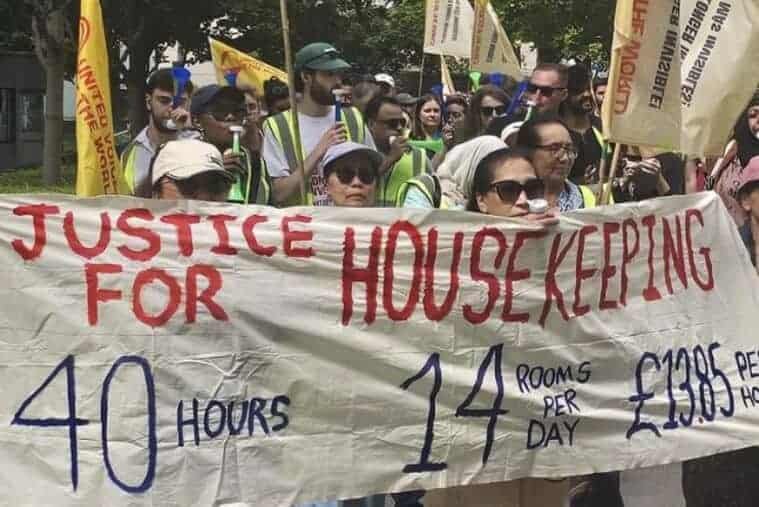
Hospitality workers taking collective action
In many jobs, workers don’t just have do the job. They also have to act like they really want you to have a nice day.
Arlie Hochschild first analysed this “emotional labour” in her 1983 book, The Managed Heart: Commercialisation of Human Feeling.
Hochschild starts with Karl Marx’s descriptions of child labourers working in appalling conditions in Victorian factories.
She contrasts this physical labour with the work of a flight attendant in 20th century America. She might have to perform some physical labour, pushing a trolley or lifting bags, but she is also supposed to fake an emotional response.
Hochschild argues that the human cost of performing emotional labour is as harmful to the worker as the physical labour discussed by Marx.
In both cases, “the worker can become estranged or alienated from an aspect of self—either the body or the margins of the soul—that is ‘used’ to do the work.”
Emotional labour is “the management of feeling to create a publicly observable facial and bodily display.”
Hochschild distinguishes between “emotional work” and “emotional labour”. Emotion work is the emotions we show amongst family and friends.
Emotional labour involves the commercialisation of workers’ feelings which are turned into a package of emotions that is consumed by the customer.
Managers impose “feeling rules” on emotional labourers to ensure the required level of customer service.
This means workers are alienated from their own emotions.
Hochschild argues that these “feeling rules” go further than demanding simple compliance. She calls this “surface acting”. But the rules increasingly demand “deep acting.” This requires a systemic suppression of the real self.
Hochschild understood emotional labour as the product of managerial control in the service sector. She explored how the commodification of emotions intensifies the alienation that shapes all wage labour.
Emotional labourers have no choice but to struggle for a free and dignified sense of themselves against the managers’ demands for better performance.
More recently, feminist writers have developed Hochschild’s analysis in new directions. In They Call It Love: The Politics of Emotional Life, Alva Gotby builds the concept of emotional labour into “emotional reproduction”.
Gotby argues that the commodification of emotions at work is one element of a wider process of emotional reproduction. This is not considered to be real work, but contributes to the well‑being of others.
All reproductive labour, she writes, has an emotional aspect—soothing, caring, intimacy.
It is women who are largely responsible for making others feel good. Gotby wants to make all women’s unpaid work “visible”.
She calls for the “denaturalisation of femininity” and a recognition that capitalism depends on emotional reproduction.
This has been popularised as a “mental load” carried by women who take responsibility for the feelings and well-being of those they care for.
But recognising and redistributing this mental load does not go far enough. All the pressures of the family should be shared equally. But even if they were, the institution of the family would continue to shape women’s lives.
The privatised family socialises women into being self-sacrificing and nurturing, as well as structuring their access to jobs.
The system could not function without the hours of unpaid labour, mostly performed by women, that go into caring for the current and next generations of workers.
Removing emotional labour from the workplace and locating it in the home robs the idea of its power to encourage active resistance.
To free our emotions, we need to replace the private family with collective provision that gives people real freedom.
And that depends on challenging the bosses where we have power—at work.
The US used to see it as a benefit for itself to fund robust disease surveillance networks across the region. It kept emergency teams of local health workers to take charge of public health crises.
But much of that ended when president Donald Trump shut down the US Agency for International Development (USAID) early last year. His “America First” policies declared that spending on aid was a “waste,” describing African countries as “shitholes.”
The Centres for Disease Control and Prevention also lost hundreds of experts, including some in the DRC, who would have helped contain the epidemic.
Last autumn, the Trump administration sacked hundreds of government scientists, including those working for the Epidemic Intelligence Service that specialised in combating Ebola.
These cuts have consequences.
The first known death in this outbreak was a nurse, on 27 April, which suggests that the virus has been spreading since early April. A delay in confirming the first likely cases of Ebola in the most recent outbreak happened because the samples were transferred to a laboratory at the wrong temperature.
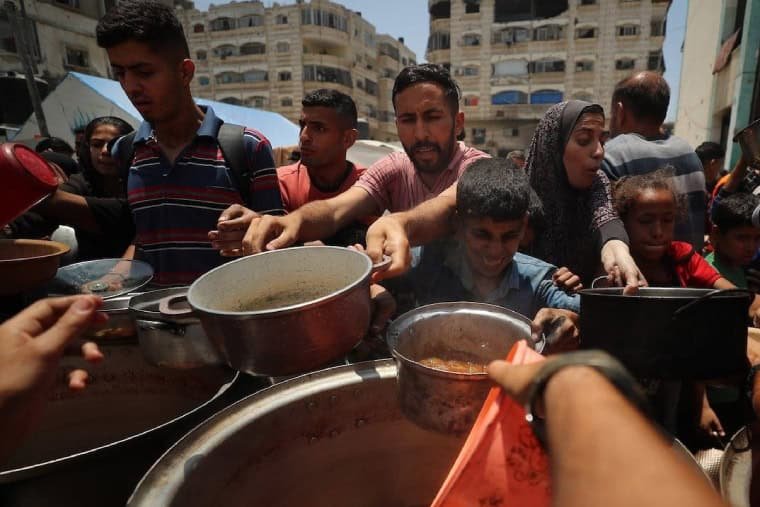
USAID would once have funded and managed that task. But no longer.
Congolese doctors are Ebola experts, but in previous outbreaks, they counted on US help with coordination and crucial supplies. Now that help has been reduced to a trickle.
The WHO budget has been cut by around 21 percent since January 2025, when Trump told the organisation the US was withdrawing from it. The US decision took effect this January and was then followed by Argentina.
Failure to quickly identify Ebola transmission allowed it to spread unchecked. Now there are cases in Goma, a Congolese city of more than a million people on the border with Rwanda.
Big power rivalry drives horrific war
There can be little doubt that the decades-long war in the DRC hampers all attempts to stop Ebola.
It is often presented as an “ethnic conflict” that defies rational explanation.
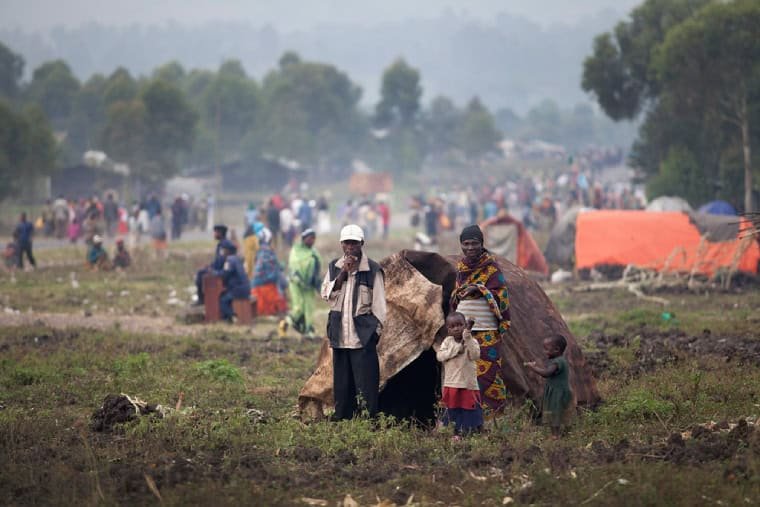
In reality, many of the world’s major powers are heavily invested in it. They have backed various governments, militias and the armies of neighbouring countries in the hope of grabbing “their share” of the DRC’s wealth.
The West is keen not only to take the region’s minerals for itself, but it also wants to prevent others, such as China and Russia, from snatching a share.
Russia has offered the DRC government political support and military hardware in exchange for natural resources. Meanwhile, China dominates the extraction, processing and export of most of the country’s cobalt.
The US and Britain have at times given both Rwanda and Uganda their backing, seeing them as “security partners.” That’s despite the United Nations gathering significant evidence that both countries have backed the M23 militias operating in the east of the DRC. And China has itself at times backed Rwanda.
The Congolese president recently offered Trump a deal—to assist his government in defeating these rebel militias in exchange for access to the minerals.
Western multinationals—including Apple, Google’s Alphabet, Microsoft, Dell and Tesla—depend on cobalt, much of it Congolese. Here, miners are as young as six years old and earn less than a dollar a day.
Extraction, rather than uplifting the DRC, is driving war and disease, and is making the working class poorer.
Overseas aid cuts – is this the end of ‘soft power’?
Trump’s cuts to overseas aid—and those of Britain’s—have undoubtedly worsened the Ebola crisis gripping central Africa.
The head of the campaigning charity Refugees International says US funding for the DRC dropped from over
$900 million in the last year of the Biden government to around
$179 million in the first year of Trump’s. That decrease has devastated an already weak health system, wrecked by war. But the US funding of USAID and the WHO, for example, was never simply philanthropy. All world powers use aid as a way of getting what they want, particularly in the Global South.
As opposed to the “hard power” of the military and war, aid was part of a plan for “soft power,” that could capture hearts and minds.
That’s why USAID food and medicine sacks transported to disaster zones are emblazoned with the slogan, “A gift of the people of the United States of America.”
Central Africa was a battleground for the main imperial powers during the Cold War of the 1950s and 60s, when the “Belgian Congo” was struggling for independence.
The US was determined that Russia should not win allies on the continent.
Instead, it wanted to influence Africa’s new rulers—and its offer of food, medicine, training and weaponry was designed to lure them in.
Those who resisted—including the first Congolese prime minister, Patrice Lumumba—were assassinated.
Aid came with strings that meant tying newly independent countries to the West through trade and credit, and politically tying an emerging African ruling class to the West. The purpose of aid was to create dependency.
In return for the West’s “generosity,” countries receiving aid were expected to be “hospitable” to imperialist military bases, spies and trade missions—and to act as outposts in times of regional conflict.
In time, it was also demanded that they open up their economies to the ravages of the free market and to repay international loans by slashing state spending. And if that led to revolt and rebellion that “soft power” could not deal with, there was of course “hard power” to fall back on. And that’s something that the Congolese people know to their cost.
More Stories
What makes Marxism scientific? – a scientific enquiry
The global rebellion of youth and workers and the war frenzy of the ruling class
Build the 20 November youth strike! Down with militarism! Down with capitalism!