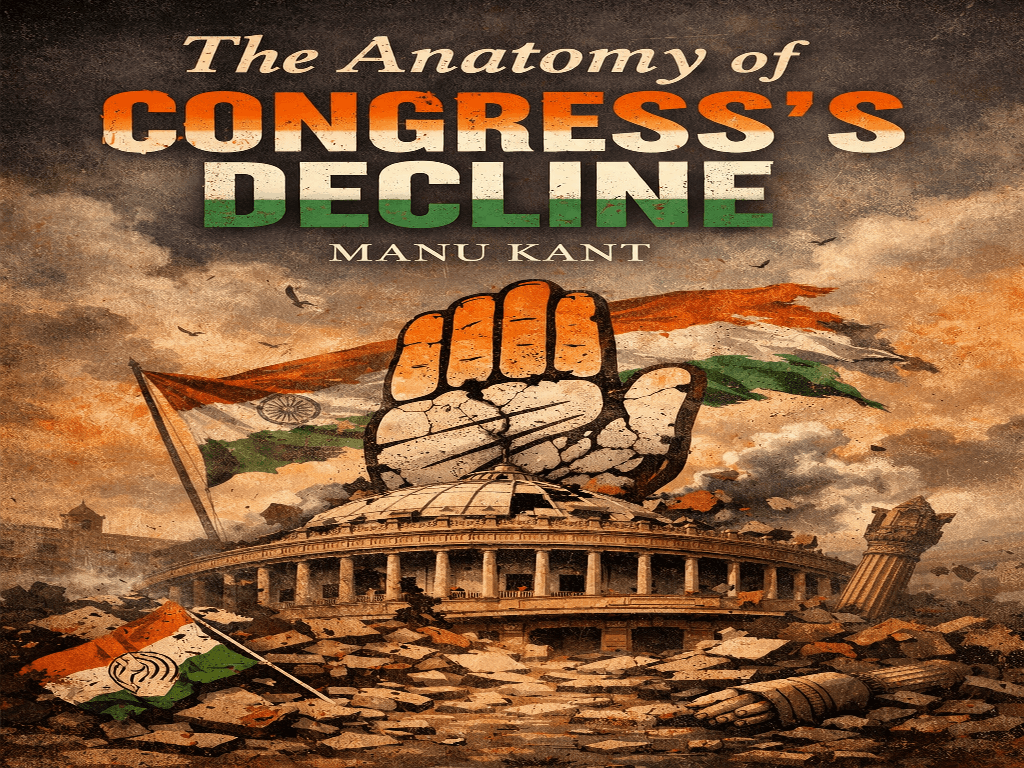
By Manu Kant
The decline of the Indian National Congress is not simply an electoral setback. It is the outcome of deeper transformations in the material structure of Indian society and the changing balance of class forces. What appears as organisational weakness or leadership failure is, in essence, the erosion of the historical conditions that once sustained Congress dominance.
In the decades following Independence, Congress functioned as a classic “umbrella” formation of the ruling bloc. It brought together sections of the bourgeoisie, landlords, the middle classes, and segments of the working masses within a single political framework. Its legitimacy flowed from its leadership of the anti-colonial struggle, but its durability rested on its capacity to mediate contradictions between these classes without fundamentally resolving them.
This mediation was anchored in a specific economic model. State-led industrialisation, planning, and the expansion of the public sector were not merely developmental choices; they were instruments through which the postcolonial state sought to balance competing class interests. Measures such as bank nationalisation under Indira Gandhi carried symbolic weight, projecting the state as an agent of redistribution while leaving the underlying relations of production intact.
At the same time, the expansion of public employment and state institutions created a relatively secure middle class that became a key social base of Congress. Sections of the peasantry and working population were incorporated through limited welfare, subsidies, and patronage networks. This arrangement enabled Congress to function as the central axis of the political system, managing contradictions while preserving the broader framework of accumulation.
However, this equilibrium was inherently unstable. By the late twentieth century, the limits of the state-led model had become evident. Economic liberalisation marked a decisive shift, integrating India more deeply into global capitalism and tilting the balance more openly in favour of large domestic and international capital. The role of the state was reconfigured—from a direct participant in production to a facilitator of market-led accumulation.
This transition has had profound political consequences. The capacity of the state to offer material concessions—through public sector expansion, secure employment, or meaningful redistribution—has been progressively constrained. As pressures of profitability, fiscal discipline, and global competition intensify, the space for accommodating diverse class interests narrows. The material basis of Congress’s broad social coalition has therefore steadily eroded.
Congress today faces a structural dilemma. It can neither return to its earlier model, given the changed configuration of global and domestic capital, nor has it articulated a coherent alternative that redefines its relationship with the working masses. Its politics thus appears vacillating—caught between rhetorical commitment to welfare and practical accommodation to the imperatives of capital.
This weakening has opened space for other political forces. The Bharatiya Janata Party has consolidated itself as the principal political organiser of the dominant bloc, combining ideological mobilisation with organisational depth. In a period marked by sharpening inequalities and economic stress, such formations offer a more cohesive mechanism for managing crisis, while simultaneously deploying cultural and national narratives to secure mass consent.
Alongside this, formations like the Aam Aadmi Party have emerged, reflecting the aspirations and anxieties of the urban petty bourgeoisie. This class, squeezed between big capital and the working masses, oscillates constantly—resentful of the former, yet fearful of the latter. Its politics is therefore marked by instability: reformist in language, but limited in scope. The emphasis on governance and service delivery does not challenge the underlying structure of accumulation; it seeks instead to stabilise it through efficiency. This is reformism without transformation, rooted in a class that desires change but fears its consequences.
The decline of Congress must therefore be understood as part of a broader reconfiguration of political representation under contemporary capitalism. As structural contradictions deepen—between labour and capital, between growth and inequality—the ability of centrist formations to indefinitely mediate and absorb these tensions diminishes. The space they once occupied contracts.
In such conditions, political tendencies move towards greater centralisation and ideological consolidation. The management of crisis increasingly demands discipline, coherence, and the capacity to enforce order. This further disadvantages formations like Congress, whose historical strength lay in flexibility and accommodation rather than in decisive direction.
It would be incorrect to assume that Congress will disappear entirely. Historical formations rarely vanish; they persist, adapt, and reconfigure. However, its earlier role as the dominant integrative force of Indian politics cannot be restored without a fundamental transformation of the conditions that once sustained it.
The anatomy of its decline, therefore, lies in the exhaustion of a specific historical project. Congress was the political expression of a particular phase of Indian capitalism—one in which the state could mediate, distribute, and balance. That phase has now given way to a more sharply polarised order. The return to that earlier equilibrium is not merely difficult; it is structurally foreclosed.
What emerges in its place will be shaped by how these contradictions are contested and resolved. But the era in which Congress could stand at the centre of the system, absorbing and managing all tensions, has definitively passed.
More Stories
Police in India arrest hundreds in bid to suppress mounting worker unrest