The Ansar Allah-led national government in Sanaa has stunned the world with a lightning offensive, liberating significant territory and taking full control of the strategic Bab al-Mandeb strait.
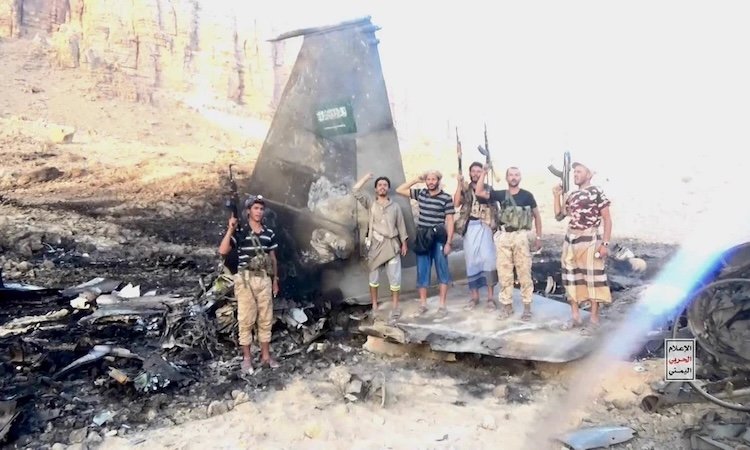
Yemeni fighters pose with the wreckage of an F15SA, the first fighter plane of its kind to be shot down with a surface-to-air missile. The tail number (5529) confirms that it is from the 55th squadron of the Saudi airforce, based at the King Khaled airbase.
Yemen has seen four years of uneasy de facto truce since a UN-negotiated ceasefire in 2022, which lasted until Saudi Arabia bombed Sanaa airport on 13 July 2026. Sanaa is Yemen’s capital and the seat of a national government led by the resistance movement Ansar Allah (referred to in western press as ‘Houthi rebels’) in alliance with other patriotic national-liberation forces.
In response, the national government in Yemen’s liberated northwest declared the ceasefire to be null and void and began to mobilise itself for a new chapter in its war to overthrow the quisling ‘internationally-recognised government’ that was installed over a decade ago in Aden and propped up by military forces from Saudi Arabia and the UAE, under the military and political direction of Anglo-American imperialism.
Following a fresh mobilisation, the Sanaa government carried out a successful offensive in southwestern Yemen, liberating some areas that have been under the control of the puppet regime in Aden since 2015.
Could this be a turning point in the struggle to liberate the rest of Yemen from imperialist control? And what does this mean for the wider Axis of Resistance to Anglo-American imperialist domination in the middle east?

Ansar Allah advances overturn western media narrative
After the offensive began on 3 September, sources within the Presidential Leadership Council (PLC, an umbrella including the so-called ‘national army’ and various armed groups loyal to the Saudi-backed regime), claimed that they had recaptured Hays, near the Red Sea coast, and had also advanced around the cities of Taiz and Marib. (Yemeni army makes gains in Al-Jawf and launches attacks on southern and northern Ma’rib fronts, Yemen Monitor, 9 September 2026)
The Saudi-backed forces were quick to spell out the victory they were envisaging. The PLC’s Rashad al-Alimi told Al Jazeera: “Our armed forces will continue to carry out their constitutional duty until state institutions are restored and their authority extends over the entire territory of Yemen.”
Another PLC spokesman claimed that the counteroffensive would “liberate Yemen from the grip … [of Ansar Allah] … and restore Sanaa as a capital for all Yemenis.” (Yemeni forces launch counteroffensive against Houthis, vow to retake Sanaa, Al Jazeera, 8 September 2026)
Nato insists on referring to these Saudi-Nato puppets as the official ‘government’ (although its ‘leaders’ are held hostage in Saudi Arabia!), in order to provide a cover for its aggressive and genocidal war of intervention under an apparently ‘domestic’ flag.
In reality, these Saudi-Nato PLC puppets have been displaced from the main centres of Yemen, including the capital Sanaa (and so have named Aden as their ‘temporary capital’) and currently control territories that, while physically very big, are, being mainly desert, actually home to less than 20 percent of the nation’s population. The PLC regime is referred to in western legacy media as the ‘Yemeni government’ simply because the collective west has bestowed the ‘legitimacy’ of its recognition upon them – much as the same imperialist powers did with Juan Guaidó in Venezuela (remember him?)
However, most of the bold claims of the ‘internationally-recognised’ PLC forces were never verified, and by 10 September a new picture began to emerge as video footage confirmed that Ansar Allah had not only recaptured Hays but had also taken the strategic Red Sea port of Mocha.
Mocha, incidentally, is the ancient city from which the Dutch learned (stole) the secret of coffee production – hence the name. This ancient tradition gives a small indication of the depth and significance of Yemen’s culture and civilisational significance as the birthplace of the Arab peoples.
Furthermore, we learned that this had not been a lightning advance along the coastline only, but that fighting in the western highlands over the course of two weeks had simultaneously put the patriotic forces in control of key mountain passes, effectively cutting supply lines between the western Red Sea coast and the PLC-controlled mountain city of Taiz directly east of Mocha. (Houthis, Yemeni forces engaged in fierce battles: Why each front matters, Al Jazeera, 10 September 2026)
While the overnight unravelling of the established disinformation narrative perhaps led to an exaggerated impression regarding the suddenness of the Saudi reversal, the success of the national government’s offensive in capturing what were assumed to be secure rear areas must have taken the PLC by surprise, since the advancing force was able to free at least 200 political and military prisoners from PLC-run jails. (Freed Houthi prisoners arrive in Sanaa after west coast offensive, Reuters Connect, 12 September 2026)
The confusion of the PLC retreat is also underlined by footage of Ansar Allah-led troops capturing caches of weapons and garages full of Toyota Land cruisers, along with housing compounds built by the UAE and Saudi backers of their respective ‘government’ factions.

Questions about this article? Ask Socialism AI
Following the severance of supply lines and the PLC’s rout at Mocha, the rest of the Yemen’s Red Sea coast was taken very quickly. On the morning of 11 September, the last coastal town of Dhubab fell to the liberators. National-liberation forces reached the Bab el-Mandeb strait and landed on Perim island, which bisects the vital shipping lane, unopposed. (Houthis close in on Bab el-Mandeb as Saudi Arabia strikes back, Indian Express, 14 September 2026)
Since then, Ansar Allah has captured all of Yemen’s Red Sea islands and advanced down the coast as far as al-Aradi. It has also turned inland to capture strategic positions in the southern highlands and conducted another advance around the central city of Marib, which lies directly east of Sanaa. In the mountains, there are two major combat areas – in the south, and to the east of the major city Taiz, from which the national-liberation forces were forced to retreat in 2015 (Iran update, Institute for the Study of War, 14 September 2026).
Since the Saudi attack, Ansar Allah-led forces have taken advantage of their improved drone and missile capabilities to strike Saudi-Arabian oil infrastructure, including the Jizan oil refinery and the kingdom’s crucial East-West pipeline. Jizan is home to a 400,000 barrel-per-day oil refinery, which is among the country’s largest, along with associated plants and energy infrastructure.
“More refined oil products than usual were shipped from Jizan in the first few months of the US-Iran war as the conflict crimped Saudi exports from the Gulf, but volumes dropped dramatically after the Houthis restarted their attacks. No oil products were shipped from Jizan in August, according to data compiled by Kpler.” (Saudi Aramco oil facilities hit in new strikes by Verity Ratcliffe et al, Financial Times, 7 September 2026)
The East-West pipeline, also known as the Petroline, is a 1,201km (746 mi) pipeline in Saudi Arabia that runs from the Abqaiq oil field in the Eastern province (near Bahrain and Qatar on the Persian Gulf coast) across the width of the Arabian peninsula to Yanbu on the Red Sea.
The first pipe on the route was built to carry natural gas during the Iran-Iraq war in the 1980s, allowing Saudi exports to bypass the tanker war that was then taking place in the strait of Hormuz. It was later converted to carry oil and supplemented by further pipes, steadily increasing its capacity in a move that was aimed at undermining the danger of Iran one day retaking control of and closing Hormuz – a threat that analysts in 2012 dismissed as mere sabre-rattling according to an FT article written at the time. (Pipelines bypassing Hormuz open by Javier Blas, 15 July 2012)
In the early part of the US-led aggressive regime-change war against Iran, the Saudis had been able to export up to 5mn barrels of oil per day despite the closure in Hormuz, using the East-West pipeline and Red Sea route. This bought vital breathing space both for the Saudi regime, whose dictatorship is totally dependent upon oil exports, and for the imperialist warmongers.
It was a significant factor in helping the US regime to hold back the arrival of the kind of catastrophic oil shock that would send the global economy spiralling into full-blown depression, thus enabling the Trump White House to continue spinning the suicidal attack as a “great success” and to incessantly declare “imminent victory”.
The pipeline route has now been closed as a result of resistance bombing that is thought to have been coordinated between Yemeni and Iraqi resistance forces. Photographs show the pipe having been seriously damaged in multiple places, meaning there will be no quick recovery. The Saudi government has said merely that the closure was a “precautionary measure”.
According to the Associated Press: “Shipping through the Bab al-Mandeb strait had fallen by about 60 percent since the Houthis began attacking some ships there in late 2023 and expressing solidarity with Palestinians in Gaza. Shipping increased this year as Saudi Arabia sought alternatives to the strait of Hormuz, but renewed Houthi threats have ‘curtailed’ that activity, according to Lloyd’s List Intelligence.
“That has forced Saudi Arabia to find yet another alternative, sending its oil north out of the Red Sea to the Mediterranean, either via the Suez Canal or a pipeline through Egypt, a far longer route for its clients in Asia. The Houthis have threatened that route as well, striking a Saudi vessel in the north of the Red Sea in late August.” (Saudi Arabia shuts down a pipeline as Houthis seize an island, opening a new front in the Iran war by Fatma Khaled et al, 12 September 2026)
The repercussions of simultaneously degrading Saudi oil infrastructure and blockading both the Bab al-Mandeb and the strait of Hormuz cannot be overstated – either for the Saudi economy or for global oil supplies. As the Anglo-American imperialist camp continues to ratchet up its middle-eastern war front in the hopes of reviving its waning hegemony and resetting its crisis-ridden economy, the price is already being felt by billions of workers around the world – and is set to rise far higher in the near future.
The imperialists’ reckless gamble, at the expense of so many lives and livelihoods, has so far not been paying off at all. A blockage of both vital shipping lanes out of the middle east has long been flagged by western analysts as the ‘ultimate nightmare’ for the very global capitalist economy that the USA and its allies are trying to bail out. As we go to press, the imperialists appear to have no viable way to escape this trap of their own making.
Meanwhile, Saudi Arabia’s King Khalid airbase near Khamis Mushait has also been struck by Ansar Allah, which targeted it “with ballistic missiles and drones last week after it was used to carry out air strikes on Yemen. At least three aircraft hangars or shelters appear to have been damaged at the Royal Saudi Air Force facility where US-made F-15 fighter jets are based.” (Financial Times, op cit)
Significance of the southern highlands for resistance forces
If Ansar Allah and the national-liberation forces continue their advances in the southern highlands, they may be able to seize control of the last PLC-controlled supply line – a single highway between Taiz and Aden that they may soon be able to approach from both sides. This could allow for the liberation of Taiz, the third largest city in Yemen, from the PLC forces and also provide ‘strategic depth’ around the Bab el-Mandeb strait.
In 2023 and 2024, the Ansar Allah-led Yemeni national government launched a blockade of Israeli-linked shipping in the Red Sea, which it later expanded to include British and US-linked ships, successfully repelling the combined naval forces of both Britain and the USA when the imperialists tried to raise this very effective siege on Israel’s Red Sea ports.
Both the blockade and subsequent drones and missile attacks against imperialist warships are thought to have been controlled primarily from Salif, some 300km away from the narrow strait itself. With the coastal towns and ports now in their hands, along with islands in the middle of the strait and a mountainous hinterland to support their coastal positions, hide launch sites and overlook Saudi forces, the gains of this offensive greatly enhance the Yemeni liberation forces’ position.
As a result, the ability of the entire Axis of Resistance to blockade the shipping of Saudi and any other hostile nation has been hugely amplified – both in the vital straits and in the Suez Canal and the Indian Ocean. Saudi Arabia is now under an effective siege – the well-deserved result of decades of complicity by its despotic rulers in imperialist crimes.
Can Yemen be liberated entirely?
While these advances are significant and Ansar Allah and the other national-liberation forces do aim to liberate all of Yemen in time, it does not necessarily follow that the rest of the country will soon be freed from Saudi occupation.
In 2015, Ansar Allah and the other patriotic forces held all these contested areas along with the southern coastal plains and were surrounding Aden where the PLC forces were holed up. That was when Saudi Arabia directly intervened using imperialist-backed air power.
The Saudi air force has hundreds of modern fast-attack aircraft that the Yemenis were unable to counter on the exposed coastal lowlands in 2015, and which will still prove a significant obstacle. To finally liberate the whole of the country from imperialist control, this air force will have to be countered or stopped from taking off. There is clearly no point in advancing large numbers of troops onto an open plain while the enemy retains the capability to pick them off from the air.
Whether Yemen has now developed the necessary capability to counter this threat is impossible for us to say at this time. On the one hand, part of what led the USA to call off its previous air and naval attacks on the Sanaa government (launched in December 2025 and called off in May 2026 amid the notorious Trump-Hegseth ‘Signal-gate’ scandal) was the fact that their modern jets were threatened by liberated Yemen’s new air defences.
Seven MQ-9 Reaper drones were downed and both F16 and F35 jets were forced into emergency manoeuvres, while two FA18 Super Hornets were reported to have “fallen off” the USS Harry S Truman aircraft carrier while it was taking “emergency evasive measures”. It is highly likely that the planes were, in reality, struck by Yemeni missiles. (F-35 had to manoeuvre to evade Houthi surface-to-air missile: US official by Howard Altman, TWZ.com, 13 May 2025)
In latest fighting, Ansar Allah-led forces have already shot down a Saudi F15 and broadcast the tail number from the wreckage (see picture above), confirming that it belonged to Saudi Arabia’s 55th squadron, which flies from the King Khaled airbase.
Coupled with this, PLC sources have told Reuters that Saudi support in this new round of fighting has included only limited air cover and has not extended to the all-out bombing of Sanaa they had requested. It seems the Saudis were deterred from complying with this request by the above-mentioned drone and missile attacks on their military and energy infrastructure. (Iranian arms and advice helped Yemen’s Houthis seize key Red Sea city, sources say by Parisa Hafezi et al, 10 September 2026)
It may be the case that between improved air defences are limiting Saudi air power to the use of expensive long-range stand-off munitions (weapons that are in critically short supply as a result of Nato’s wars against Iran and Russia), and that with the credible threat of further escalation against its oil industry, the Saudi threat may have been effectively neutralised.
If that is the case, there is the possibility that this offensive, which has already made significant gains for the anti-imperialist and patriotic forces, can be continued, becoming a turning point in Yemen’s long war for liberation.
Either way, the entire balance of middle-eastern power continues to tip away from Anglo-American imperialism and in favour for the Axis of Resistance, furthering the latter’s mission of liberating the whole of the middle east from imperialist domination and zionist infiltration and sabotage.
More Stories
The closure of the Russian House in Berlin: A blow to culture in the service of war
The commodification of education
Europe and Canada pursue realignment with new security architecture amid escalating inter-imperialist rivalries